

Quick Answer
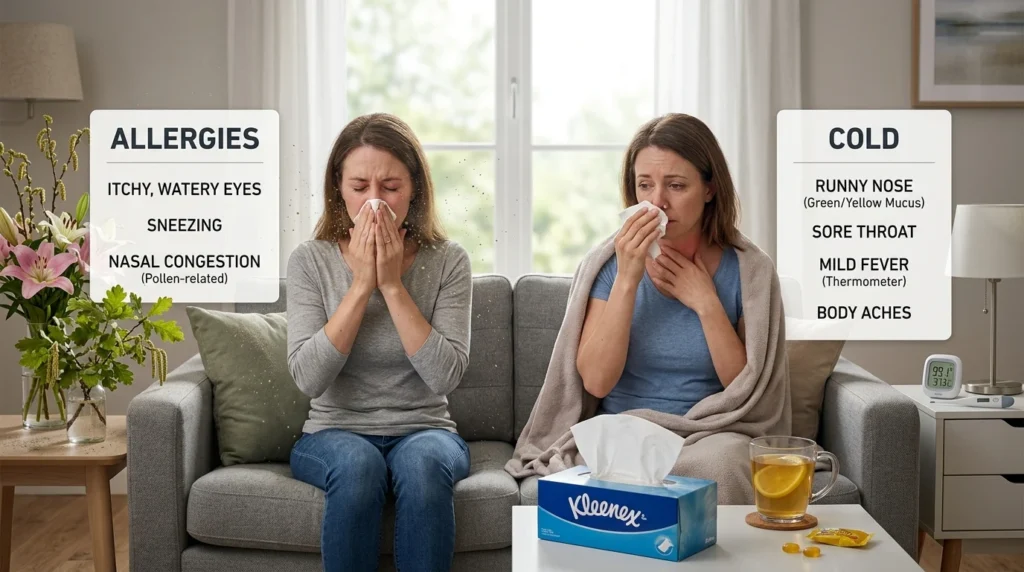
Allergies and a common cold can cause similar symptoms, especially sneezing, a runny nose, congestion, and coughing. Allergies happen because the immune system reacts to an allergen, while a cold is caused by a virus.
A runny nose, sneezing, stuffy nose, and cough can leave you wondering: Do I have allergies or a cold? The two can feel very similar, especially at the beginning. However, they have different causes and often follow different patterns.
Allergies happen when the immune system reacts to something such as pollen, dust, mold, or animal dander. A common cold, on the other hand, is a viral infection of the upper respiratory tract.
Knowing the difference can help you understand why your symptoms started, what tends to trigger them, and when it may be useful to talk with a healthcare professional.
What Are Allergies?
An allergy is an immune reaction to a substance that is usually harmless to most people.
Common allergy triggers include:
- Pollen
- Dust
- Mold
- Pet dander
- Certain foods
- Insect venom
- Some medicines
When a person with an allergy encounters a trigger, the immune system reacts to it. The symptoms depend on the type of allergy and where the allergen affects the body.
For nasal allergies, also called allergic rhinitis, common symptoms include sneezing, a runny or stuffy nose, itchy eyes, watery eyes, and an itchy nose or throat.
What Is a Common Cold?
A common cold is a viral infection that affects the upper respiratory tract.
Different viruses can cause colds. Common symptoms include:
- Runny nose
- Stuffy nose
- Sneezing
- Cough
- Sore throat
- Headache
- Mild body aches
- Sometimes a low fever
Cold symptoms often become strongest during the first few days and usually improve within about a week.
Unlike allergies, a cold is an infection and can spread from one person to another.
Allergies or Cold: What Is the Main Difference?
The biggest difference is the cause.
Allergies are caused by an immune response to an allergen. A cold is caused by a virus.
For example, if you start sneezing every time you are around a particular type of pollen, allergies may be involved. If you spend time around someone who has a cold and then develop symptoms a few days later, a cold may be more likely.
The symptoms can overlap, so the timing and pattern matter.
| Symptom or Clue | Allergies | Common Cold |
|---|---|---|
| Sneezing | Common | Common |
| Runny nose | Common | Common |
| Stuffy nose | Common | Common |
| Itchy eyes | Common | Less typical |
| Watery eyes | Common | Less typical |
| Itchy nose | Common | Less typical |
| Sore throat | Sometimes | Common |
| Cough | Possible | Common |
| Fever | Not typical for allergic rhinitis | Sometimes |
| Body aches | Not typical | Possible |
| Triggered by pollen or dust | Common | No |
| Caused by a virus | No | Yes |
| Contagious | No | Yes |
Symptoms alone do not always give a definite answer because allergies and colds can look alike.
Allergy Symptoms to Look For
Some symptoms point more strongly toward allergies.
Itchy Eyes
Itchy, watery, or red eyes are common with allergic reactions, especially with airborne allergens.
For example, you might notice that your eyes become itchy after spending time outside during a period when pollen is high.
Itchy Nose
An itchy nose is another common allergy symptom.
You may find yourself rubbing or touching your nose repeatedly because of the irritation.
Repeated Sneezing
Both colds and allergies can cause sneezing. However, allergy-related sneezing may happen repeatedly after exposure to a trigger.
Watery Runny Nose
Allergies often cause a watery runny nose. The symptom can continue as long as you remain exposed to the trigger.
MedlinePlus lists sneezing, runny or clogged nose, itchy eyes, itchy nose, and itchy throat among common allergic rhinitis symptoms.
Common Cold Symptoms to Look For
A cold can also begin with sneezing and a runny nose, but other symptoms may become noticeable as the infection develops.
Common signs include:
- Sore throat
- Cough
- Congestion
- Headache
- Mild body aches
- Feeling tired
- Sometimes a low fever
The CDC notes that cold symptoms often peak within two to three days after they begin.
A cold can also cause symptoms that gradually change over several days.
Itchy Eyes: Allergies or Cold?
If your eyes are especially itchy and watery, allergies may be more likely.
That does not mean every person with a cold will have no eye symptoms. Symptoms can overlap. Still, itchy and watery eyes are strongly associated with allergic rhinitis.
For example:
My eyes itch every time I go outside, and I keep sneezing.
That pattern may point toward an allergy trigger.
By comparison:
I have a sore throat, cough, congestion, and I started feeling sick a few days ago.
That pattern can fit a common cold more closely.
Runny Nose: Allergies or Cold?
A runny nose can happen with both.
That is why the runny nose alone cannot tell you whether you have allergies or a cold.
With allergies, the runny nose may appear after exposure to pollen, dust, pets, or another trigger.
With a cold, the runny nose is part of a viral infection and may occur along with congestion, sore throat, cough, or other cold symptoms.
So instead of asking only, “Do I have a runny nose?” consider what other symptoms appear with it.
Sneezing: Allergies or Cold?
Sneezing occurs with both allergies and colds.
Allergy-related sneezing may be linked to a specific exposure. For example, you might start sneezing after cleaning a dusty room.
Cold-related sneezing usually appears as part of a larger group of infection symptoms.
That means sneezing by itself is not enough to tell the difference.
Cough: Allergies or Cold?
A cough can happen with both conditions.
A cold commonly causes coughing, while allergies can also cause coughing, particularly when nasal drainage irritates the throat.
The pattern matters.
If your cough appears with a sore throat, congestion, and other cold symptoms, a cold may be involved.
If it repeatedly appears around a known allergen, allergies may be contributing.
Sore Throat: Allergies or Cold?
A sore or scratchy throat is common with a cold.
Allergies can also cause throat irritation, especially when nasal drainage moves toward the throat.
Still, a sore throat combined with other infection-like symptoms may fit a cold better than a typical allergy pattern.
This is one reason it helps to consider the entire group of symptoms rather than focusing on one sign.
Fever: Allergies or Cold?
Fever can be an important clue.
A fever is not a typical symptom of allergic rhinitis. A common cold can sometimes cause a low fever, particularly in children.
However, the presence or absence of fever does not prove what illness you have.
Other infections can also cause fever, so a high or persistent fever deserves appropriate medical attention.
Body Aches: Allergies or Cold?
Mild body aches can occur with a common cold.
They are not a typical feature of allergic rhinitis.
So if you have a runny nose plus mild aches and other signs of an infection, a cold may be more likely than allergies.
However, stronger body aches can occur with illnesses other than a common cold. Symptoms that are severe or unusual should not be assumed to be caused by allergies.
How Long Do Allergies Last?
Allergy symptoms can continue for as long as you remain exposed to the trigger.
For example, someone with seasonal pollen allergies may experience symptoms during certain parts of the year. Another person may have symptoms around dust or pets throughout the year.
MedlinePlus notes that allergic rhinitis can be seasonal or related to ongoing exposure to allergens such as dust mites or animal dander.
This continuing pattern is one clue that can separate allergies from a short-term cold.
How Long Does a Cold Last?
A common cold usually improves within about a week, although some symptoms can last longer.
The illness often starts after exposure to a virus and develops over the following days.
For example:
Monday: You feel normal.
Tuesday: Your throat feels scratchy.
Wednesday: Your nose becomes congested and you start sneezing.
Thursday: You develop a cough.
That kind of progression can fit a viral respiratory infection.
Are Allergies Contagious?
Typical allergies are not contagious.
You cannot catch seasonal allergies from another person.
If two people in the same household suddenly develop runny noses, coughs, and sore throats around the same time, an infectious illness may be more likely than an allergy. Still, symptoms alone cannot establish the cause.
Allergies happen because the immune system reacts to an allergen rather than because a virus spreads from one person to another.
Is a Cold Contagious?
Yes. Common colds are caused by viruses that can spread between people.
Transmission can happen through respiratory droplets and close contact. A person can also spread a virus by touching contaminated surfaces and then touching their eyes, nose, or mouth.
That is one major difference between a cold and an allergy.
You can be around someone with allergies without catching their allergy.
You can, however, catch a cold virus from an infected person.
Can Allergies Happen at the Same Time as a Cold?
Yes.
Having allergies does not prevent someone from getting a cold.
A person might already have seasonal allergies and then develop a viral infection.
That combination can make symptoms harder to understand because both conditions may contribute to congestion, coughing, or a runny nose.
If symptoms seem unusual, severe, or persistent, it is better to discuss them with a healthcare professional rather than trying to identify the cause from one symptom alone.
Allergies or Cold in Different Seasons
Season can provide a clue, but it is not a perfect test.
Seasonal allergies often become noticeable during periods when certain plants release pollen. Pollen levels can vary with weather and location.
Colds can happen throughout the year.
The CDC notes that people can get colds at any time of year.
Therefore, having symptoms during spring does not automatically mean you have allergies, and getting sick during winter does not automatically mean you have a cold.
Allergies or Cold After Being Around Someone Sick
Suppose someone in your home has a cold.
A few days later, you develop congestion, sneezing, a sore throat, and a cough.
That pattern can fit a cold because respiratory viruses spread between people and cold symptoms often begin after an incubation period.
Now consider another situation.
You clean a dusty room and quickly develop sneezing, an itchy nose, and watery eyes.
That pattern may fit an allergic reaction more closely.
The timing of symptoms can provide useful information.
Allergies or Cold After Going Outside
Going outside can lead to either situation, depending on what happens next.
If outdoor exposure repeatedly causes itchy eyes, sneezing, and a runny nose, an environmental allergen such as pollen may be involved.
If you simply go outside and later develop symptoms of a respiratory infection, the outdoor setting itself does not prove that you have allergies.
Pollen exposure can trigger allergic rhinitis in people who are sensitive to it.
Treatment Is Different
Because allergies and colds have different causes, their management is different.
For allergies, reducing exposure to the trigger can help. Depending on the symptoms, healthcare professionals may also recommend medicines such as antihistamines or nasal treatments.
A common cold has no cure that immediately removes the virus. Rest, fluids, and medicines that relieve symptoms can help you feel more comfortable while the illness runs its course. Antibiotics do not treat a common cold because colds are caused by viruses.
The right treatment depends on the person, symptoms, age, and medical history.
When to Talk to a Doctor
Most mild allergies and common colds can be managed without emergency care.
However, you should seek medical advice when symptoms are severe, unusual, getting worse, or not improving as expected.
For a cold, MedlinePlus advises contacting a healthcare provider for concerns such as trouble breathing, dehydration, a fever lasting more than four days, symptoms lasting more than ten days without improvement, or symptoms that improve and then return or worsen.
For allergies, medical advice can be useful when symptoms are severe, treatment no longer works, or symptoms do not improve with treatment.
Common Mistakes People Make
Assuming Every Runny Nose Is a Cold
A runny nose can come from allergies as well as a cold.
Assuming Every Springtime Illness Is an Allergy
Seasonal timing can suggest allergies, but viruses can circulate during any season.
Using Antibiotics for a Cold
Antibiotics do not treat the viruses that cause common colds.
Ignoring Itchy Eyes
Itchy, watery eyes can be an important clue when nasal symptoms are present.
Focusing on Only One Symptom
Sneezing alone cannot tell you whether you have allergies or a cold.
Look at the entire pattern.
Allergies or Cold: Simple Comparison
| Feature | Allergies | Common Cold |
|---|---|---|
| Main cause | Immune reaction to an allergen | Virus |
| Contagious | No | Yes |
| Itchy eyes | Common | Less typical |
| Watery eyes | Common | Less typical |
| Sneezing | Common | Common |
| Runny nose | Common | Common |
| Congestion | Common | Common |
| Cough | Possible | Common |
| Sore throat | Possible | Common |
| Fever | Not typical | Sometimes |
| Body aches | Not typical | Possible |
| Triggered by allergens | Yes | No |
| Can happen year-round | Yes, depending on trigger | Yes |
| Often improves after avoiding trigger | Yes | No |
This comparison can help you notice patterns, but it cannot replace a medical diagnosis.
Practice Questions
Question 1
You have itchy, watery eyes and start sneezing whenever you are around pollen.
What is more likely?
Answer: Allergies.
The connection with pollen and the itchy, watery eyes fit an allergic pattern.
Question 2
You develop a sore throat, congestion, cough, and mild body aches after someone in your home gets sick.
What is more likely?
Answer: A common cold may be more likely.
The exposure to someone who is sick and the group of symptoms fit a respiratory infection.
Question 3
You have a runny nose.
Does that automatically mean you have a cold?
Answer: No.
A runny nose can occur with both allergies and a cold.
Question 4
Can you catch allergies from another person?
Answer: No.
Typical allergies are not contagious.
Question 5
Can a cold spread from one person to another?
Answer: Yes.
Cold viruses can spread between people.
How to Think About Allergies or Cold
When you are trying to understand your symptoms, ask yourself a few simple questions:
Did I recently encounter someone who was sick?
That can point toward an infection.
Did my symptoms appear after pollen, dust, pets, or another known trigger?
That can point toward allergies.
Are my eyes itchy and watery?
That is common with allergies.
Do I have a sore throat, cough, mild aches, or fever?
Those symptoms can occur with a cold.
How long have the symptoms lasted?
A cold often improves within about a week, while allergies can continue when exposure to the trigger continues.
None of these questions can diagnose an illness by itself. Together, however, they can help you understand the difference.
Final Tips
Remember these simple points:
- Allergies come from an immune reaction to an allergen.
- A common cold comes from a virus.
- Both can cause sneezing and a runny nose.
- Itchy and watery eyes are common with allergies.
- Sore throat and cough are common with colds.
- Fever is not typical of allergic rhinitis.
- A cold can spread from person to person.
- Typical allergies are not contagious.
- Allergy symptoms may continue while you are exposed to a trigger.
- A cold usually improves within about a week.
- One symptom alone cannot always tell you the cause.
FAQs
How can I tell if I have allergies or a cold?
Look at the overall pattern. Itchy and watery eyes, repeated symptoms after exposure to pollen or dust, and symptoms that continue around a trigger can suggest allergies. A sore throat, cough, mild body aches, or symptoms following exposure to someone who is sick can fit a cold. However, the symptoms overlap, so they cannot always tell you the cause by themselves.
Are allergies or a cold more likely to cause itchy eyes?
Itchy, watery eyes are more typical of allergies, especially allergic rhinitis. Colds can affect the eyes in some cases, but strong eye itching is more closely associated with allergies.
Can allergies cause a runny nose like a cold?
Yes. Both allergies and colds can cause a runny nose. The presence of a runny nose alone cannot tell you which one is responsible.
Can you have allergies and a cold at the same time?
Yes. A person can have allergies and also develop a cold. When both occur together, symptoms can overlap and become harder to identify from symptoms alone.
How long does a cold usually last compared with allergies?
A common cold usually improves within about a week, although some symptoms can last longer. Allergy symptoms can continue for as long as the person is exposed to the allergen.
Conclusion
Allergies or cold can be difficult to tell apart because both can cause sneezing, congestion, coughing, and a runny nose. The biggest difference is the cause. Allergies happen when the immune system reacts to an allergen, while a common cold is caused by a virus.
Look at the complete symptom pattern rather than one symptom. Itchy and watery eyes, repeated reactions to pollen or dust, and symptoms linked to a specific trigger can point toward allergies. A sore throat, cough, mild aches, and a short-term illness can fit a common cold more closely.
If symptoms are severe, last longer than expected, keep getting worse, or cause breathing problems, medical advice is appropriate. A healthcare professional can look at the full picture and determine what may be causing the symptoms.