

Quick Answer
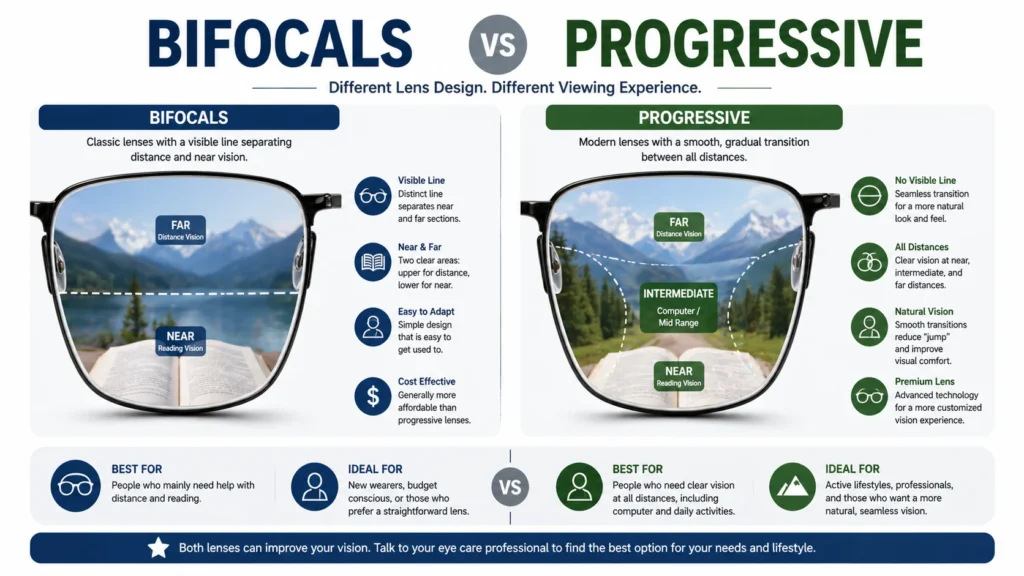
Bifocals and progressive lenses are two types of eyeglasses used to correct vision at multiple distances. Bifocals have two distinct sections for near and far vision, while progressive lenses provide a smooth, gradual transition between distances without visible lines. Progressive lenses offer a more natural vision experience, while bifocals are simpler and often more affordable.
Many people face vision changes as they age. Reading becomes harder. Distance vision may also blur. Because of this, people look for glasses that can help them see clearly at different distances. This is where bifocals and progressive lenses come in.
At first, both options may seem similar. They both correct near and far vision. However, they work in very different ways. Bifocals have clear sections in the lens. Progressive lenses, on the other hand, change power smoothly from top to bottom.
Choosing between bifocals vs progressive lenses is important. It affects comfort, daily activities, and even confidence. Some people prefer the simplicity of bifocals. Others like the modern design of progressive lenses.
In this guide, you will learn everything about bifocals vs progressive lenses. We will cover how they work, benefits, drawbacks, costs, real life examples, common mistakes, and expert insights. The explanation is simple, clear, and useful for everyone.
Quick Overview
Bifocals have two lens sections
Progressive lenses have smooth transition
Bifocals show a visible line
Progressive lenses have no line
They are simple
Progressive lenses are more advanced
Key Difference Between Bifocals vs Progressive


The main difference is how the lenses are designed.
Bifocals split the lens into two parts
Progressive lenses blend multiple powers smoothly
Because of this, progressive lenses provide more natural vision.
How Bifocal Lenses Work


Bifocal lenses have two distinct sections. The top part is used for distance vision. The bottom part helps with near tasks like reading.
When a person looks down, they use the reading section. When they look straight ahead, they use the distance section.
However, the sudden change between sections can feel uncomfortable at first.
How Progressive Lenses Work


Progressive lenses do not have visible lines. Instead, they offer a gradual change in lens power from top to bottom.
Top area for distance
Middle for intermediate tasks like computer use
Bottom for reading
This smooth transition makes vision more natural and comfortable.
Comparison Table
| Feature | Bifocals | Progressive |
|---|---|---|
| Lens design | Two sections | Multiple smooth zones |
| Visible line | Yes | No |
| Vision transition | Sudden | Gradual |
| Comfort | Moderate | High |
| Cost | Lower | Higher |
| Adaptation | Easy | Takes time |
Definition of Bifocals
Bifocals are eyeglasses with two lens powers. They help people see both near and far objects.
The lens is divided into two parts. The lower part is for reading, while the upper part is for distance.
Bifocals are simple and have been used for many years.
Definition of Progressive Lenses
Progressive lenses are advanced eyeglasses that offer multiple vision corrections in one lens.
They allow smooth focus at different distances without visible lines. Because of this, they look like regular glasses.
Main Differences Explained
The biggest difference between bifocals vs progressive lenses is the viewing experience.
Bifocals create a jump between near and far vision.
Progressive lenses offer a smooth transition.
Bifocals are easy to use but less flexible.
Progressive lenses are more natural but require adjustment.
Vision Comfort and User Experience
Comfort plays a major role in choosing lenses.
Bifocals may cause image jump when switching focus.
Progressive lenses reduce this effect and feel more natural.
However, progressive lenses may take time to adjust.
Cost Comparison
Cost is another important factor.
Bifocals are usually cheaper.
Progressive lenses are more expensive due to advanced design.
People with budget limits may choose bifocals.
Advantages and Disadvantages
Advantages of Bifocals
Affordable
Easy to use
Quick adjustment
Disadvantages
Visible line
Limited vision zones
Advantages of Progressive
Natural vision
No visible lines
Multiple focus areas
Disadvantages
Higher cost
Adjustment period
Real World Examples
1 Example One Office Work
A person using a computer prefers progressive lenses for smooth transition.
2 Example Two Reading
Someone who mainly reads may find bifocals sufficient.
3 Example Three Daily Activities
Progressive lenses help with driving, reading, and screen use without switching glasses.
Common Mistakes
1 Mistake: One Thinking Both Are the Same
Correction They have different designs
2 Mistake: Two Choosing Based Only on Price
Correction Comfort is also important
3 Mistake: Three Ignoring Adjustment Period
Correction Progressive lenses need time to adapt
Related Comparisons
Single vision vs bifocal
Bifocal vs trifocal
Progressive vs reading glasses
Beginner to Advanced Understanding
Beginner Level
Bifocals have two sections
Progressive lenses are smooth
Intermediate Level
Bifocals are simple
Progressive lenses are advanced
Advanced Level
Lens technology affects comfort, adaptation, and visual performance
Lifestyle Considerations
Active people prefer progressive lenses.
Simple users may prefer bifocals.
Choice depends on daily activities and comfort needs.
Exercises With Answers
One Question
Which lens has visible line
Answer Bifocals
Two Question
Which provides smooth transition
Answer Progressive lenses
Three Question
Which is more affordable
Answer Bifocals
Four Question
Which takes time to adjust
Answer Progressive lenses
Five Question
Which is more modern
Answer Progressive lenses
FAQs
What is the main difference between bifocals vs progressive lenses?
Bifocals have two sections, while progressive lenses provide smooth transition between distances.
Are progressive lenses better than bifocals?
They offer more natural vision, but they cost more and need adjustment.
Which is cheaper bifocals or progressive?
Bifocals are usually cheaper.
Do progressive lenses have a line?
No, they are line free.
Are bifocals outdated?
No, they are still widely used.
Can beginners use progressive lenses?
Yes, but they may need time to adjust.
Which is best for computer use?
Progressive lenses are better for multiple distances.
Do bifocals cause discomfort?
Some users feel a jump between vision zones.
Conclusion
Bifocals vs progressive lenses is an important comparison for people with vision needs. Bifocals are simple, affordable, and easy to use. Progressive lenses are modern, smooth, and more natural.
Both options have benefits and drawbacks. Bifocals work well for basic needs, while progressive lenses provide better comfort and flexibility.
Choosing the right lens depends on lifestyle, budget, and comfort. Understanding these differences helps you make the best decision for clear and comfortable vision.