
Quick Answer
ASL in text commonly means “Age, Sex, Location?” It is an old-school chat abbreviation used to ask someone their age, gender, and where they are from or located.
ASL meaning in text usually refers to the abbreviation “Age, Sex, Location?”, a phrase that became popular in early internet chatrooms and instant messaging. Someone using ASL is traditionally asking three basic personal questions: how old you are, your sex or gender, and your location.
The abbreviation became strongly associated with early online conversations, especially anonymous chats where people did not know each other in person. Today, younger users may recognize ASL as an older internet expression rather than a normal everyday texting phrase.
ASL also has another major meaning: American Sign Language, the visual language used by many Deaf and people in the United States and parts of Canada. Context is therefore essential when interpreting ASL. In this article, the focus is its traditional texting meaning while also explaining the important distinction.
Key Facts About ASL
| Fact | Details |
|---|---|
| Common Text Meaning | Age, Sex, Location? |
| Other Major Meaning | American Sign Language |
| Type | Internet and texting abbreviation |
| Traditional Use | Asking basic personal details |
| Pronunciation | A-S-L |
| Style | Informal |
| Common Context | Chatrooms, messaging, online conversations |
| Formal Use | Not normally recommended |
What Is ASL in Text?
ASL is an abbreviation that traditionally means “Age, Sex, Location?” in online chat.
Each letter represents one question:
- A = Age
- S = Sex
- L = Location
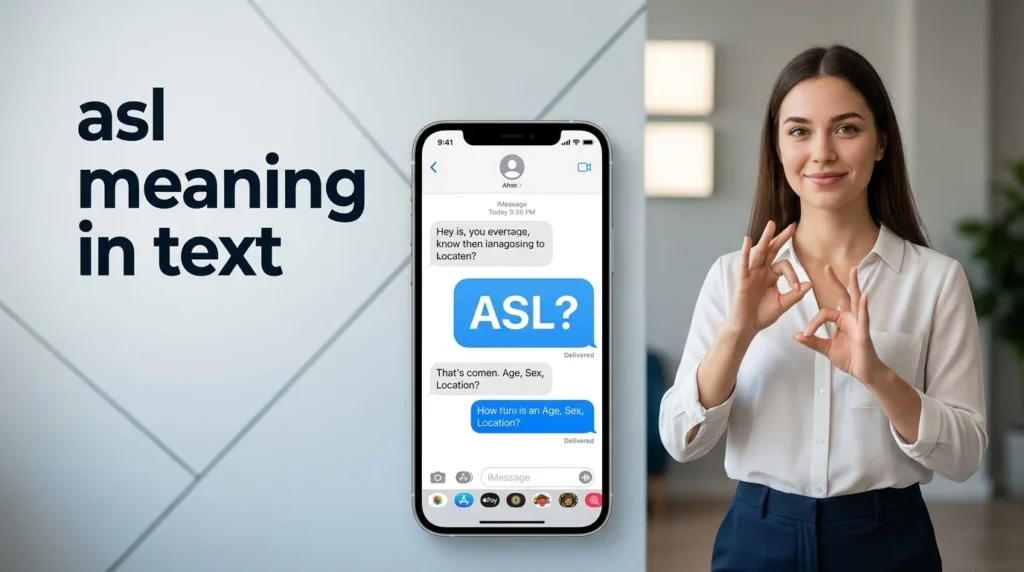
A person might type “ASL?” when they want the other person to provide those three details.
For example:
Person A: “Hi, ASL?”
Person B: “25, male, Texas.”
This style of conversation was especially common during the early years of internet chatrooms and instant messaging.
ASL Meaning in Text
The traditional ASL meaning in text is “Age, Sex, Location?” It served as a quick way for strangers to introduce themselves online.
Unlike modern abbreviations that often shorten ordinary phrases, ASL became closely tied to the culture of early anonymous internet communication.
A person might start a conversation with:
“Hey, ASL?”
The other person could then provide their age, sex, and location.
Today, the phrase can sound dated. Many people are more likely to ask these questions separately, and sharing personal details with strangers online can raise privacy concerns.
Why Was ASL Popular Online?
ASL became popular because early chatrooms encouraged short, fast messages. Users often entered conversations with people they had never met, so basic personal questions helped establish who they were talking to.
Typing three letters was much faster than writing:
“How old are you? What is your sex? Where are you located?”
ASL provided a compact version of all three questions.
The abbreviation became especially recognizable in internet chat culture before social media and modern messaging platforms became dominant.
Examples of ASL in Text
Here are some examples of how ASL was traditionally used:
“Hi, ASL?”
Meaning: “What is your age, sex, and location?”
“Can I ask your ASL?”
Meaning: “Can I ask your age, sex, and location?”
“ASL please?”
A short request for the same information.
A conversation might look like this:
Person A: “Hey, ASL?”
Person B: “28, female, Chicago.”
The abbreviation usually appears at the beginning of a conversation rather than in a detailed discussion.
How to Respond to ASL
If someone uses ASL in the traditional sense, you can answer each part separately.
For example:
“I’m 24, female, and based in New York.”
You can also choose not to provide the information. You are never required to share your age, gender, or location with an online stranger.
A simple response could be:
“I’d rather not share personal details.”
That answer is perfectly reasonable, especially when the person asking is unknown to you.
ASL and Online Privacy
The traditional use of ASL raises a privacy issue that matters more today than it did in the early days of online chat.
Age and location can reveal useful information about a person, especially when combined with other details. Someone does not need to answer an ASL request simply because another user asks.
For casual conversations, it is often safer to keep location information broad. Saying “I’m in Texas” reveals less than providing a home address or exact neighborhood.
The same principle applies to age and other personal details. Share only what feels appropriate for the situation.
ASL vs. American Sign Language
ASL has two very different meanings, which can cause confusion.
| Term | Meaning | How It Differs |
|---|---|---|
| ASL | Age, Sex, Location? | An old internet chat abbreviation |
| ASL | American Sign Language | A complete visual language |
| A/S/L | Age, Sex, Location? | An older written form using separators |
| Sign language | Visual communication systems | A broad term covering many different signed languages |
The context usually makes the intended meaning clear.
If someone writes “Do you know ASL?”, they probably mean American Sign Language.
If someone writes “ASL?” when beginning an online conversation, they may be using the older chat abbreviation.
What Does ASL Mean on Social Media?
On modern social media, ASL can still refer to “Age, Sex, Location?”, but that usage feels much less common than it did in early internet chat.
You may encounter it when someone is intentionally using old internet slang, discussing online chat history, or asking for personal information.
In other conversations, ASL may refer to American Sign Language. For example, a post about learning ASL almost certainly refers to the language.
Context matters more than the abbreviation alone.
Is ASL Still Common in Texting?
The “Age, Sex, Location?” meaning is widely recognizable as older internet slang, but it is not a standard question in everyday modern texting.
You are more likely to see ASL discussed as an example of early internet language or used jokingly.
The American Sign Language meaning remains highly relevant. That distinction is worth remembering because the same three letters can represent completely different concepts.
Common Mistakes With ASL
One common mistake is assuming ASL always means “Age, Sex, Location?” It does not. American Sign Language is another major and established meaning.
Another mistake is assuming that someone asking ASL automatically wants a detailed answer. You can choose how much personal information you share.
It is also easy to misunderstand the abbreviation when there is no context. Look at the surrounding conversation before deciding what the sender means.
When Should You Use ASL?
Use the traditional ASL abbreviation only when the conversational context clearly supports its meaning and the other person understands older internet slang.
It is not a good choice for formal writing. Instead, ask the questions directly if they are genuinely relevant.
For example, rather than writing “ASL?”, you could say:
“How old are you, and where are you from?”
That version is clearer and less likely to create confusion.
If you mean American Sign Language, write the full name when clarity matters.
FAQs
What does ASL mean in text?
ASL traditionally means “Age, Sex, Location?” in online chat. It asks someone for their age, sex or gender, and location.
What does ASL mean in texting today?
In texting, ASL can still refer to “Age, Sex, Location?”, but this meaning is associated with older internet chat culture. It can also mean American Sign Language, so context matters.
What does ASL mean from a girl?
If a girl sends “ASL?” in a traditional chat context, she may be asking for your age, sex or gender, and location. The sender’s gender does not change the abbreviation’s meaning.
What does ASL mean from a guy?
A guy using “ASL?” may also mean “Age, Sex, Location?” in an online conversation. Check the surrounding messages to confirm the intended meaning.
Does ASL mean American Sign Language?
Yes. ASL commonly stands for American Sign Language, a visual language used by many Deaf and
people. Context determines whether ASL refers to the language or the older chat abbreviation.
Is ASL an old texting abbreviation?
Yes. The “Age, Sex, Location?” meaning is strongly associated with early internet chatrooms and instant messaging. It may sound dated in modern conversations.
Is it safe to answer ASL?
You do not have to share personal information with strangers online. If you are uncomfortable, you can decline to provide your age, gender, or location.
Conclusion
ASL has two important meanings: the older internet abbreviation “Age, Sex, Location?” and American Sign Language. In texting, context determines which meaning applies.
The chat abbreviation is associated with early online culture, while American Sign Language remains a widely recognized language and important modern meaning.