
Many students, writers, teachers, and language learners search for analogy or metaphor because these literary devices seem very similar. Both involve comparisons, and both help readers understand ideas more clearly. However, they serve different purposes and are used in different ways.
A metaphor is often used to create vivid imagery and emotional impact. For example, saying “time is a thief” creates a strong image and feeling. An analogy, on the other hand, is designed to explain a concept by comparing it to something familiar. For example, comparing the human brain to a computer helps explain how information is processed.
Understanding analogy or metaphor is important for writing, communication, education, public speaking, and literary analysis. Using the correct device can make your message clearer and more effective.
This guide explains analogy or metaphor in simple language. You will learn definitions, examples, key differences, advantages, disadvantages, real world applications, common mistakes, exercises with answers, and frequently asked questions.
Quick Overview
An analogy explains.
A metaphor illustrates.
An analogy compares relationships.
A metaphor creates imagery.
Both compare things but serve different purposes.
Definition of Analogy
An analogy is a comparison between two things that helps explain an idea, concept, relationship, or process.
Writers use analogies to make complex information easier to understand.
Examples:
- The brain is like a computer processing information.
- Finding a good employee is like finding a needle in a haystack.
- Learning a language is like building a house brick by brick.
An analogy often uses multiple points of comparison.
Its primary goal is explanation.
Definition of Metaphor
A metaphor is a figure of speech that directly compares two unlike things without using words such as like or as.
Examples:
- Time is a thief.
- The classroom was a zoo.
- Her voice was music to his ears.
- Life is a journey.
Metaphors create vivid imagery and emotional meaning.
Their primary goal is expression rather than explanation.
Key Difference Between Analogy or Metaphor
The biggest difference lies in purpose.
An analogy explains an idea.
A metaphor creates an image.
Quick Comparison Table
| Feature | Analogy | Metaphor |
|---|---|---|
| Purpose | Explain | Illustrate |
| Length | Usually longer | Usually shorter |
| Complexity | Detailed | Direct |
| Focus | Understanding | Imagery |
| Common Use | Education and explanation | Literature and creativity |
| Comparison Style | Relationship based | Symbolic |
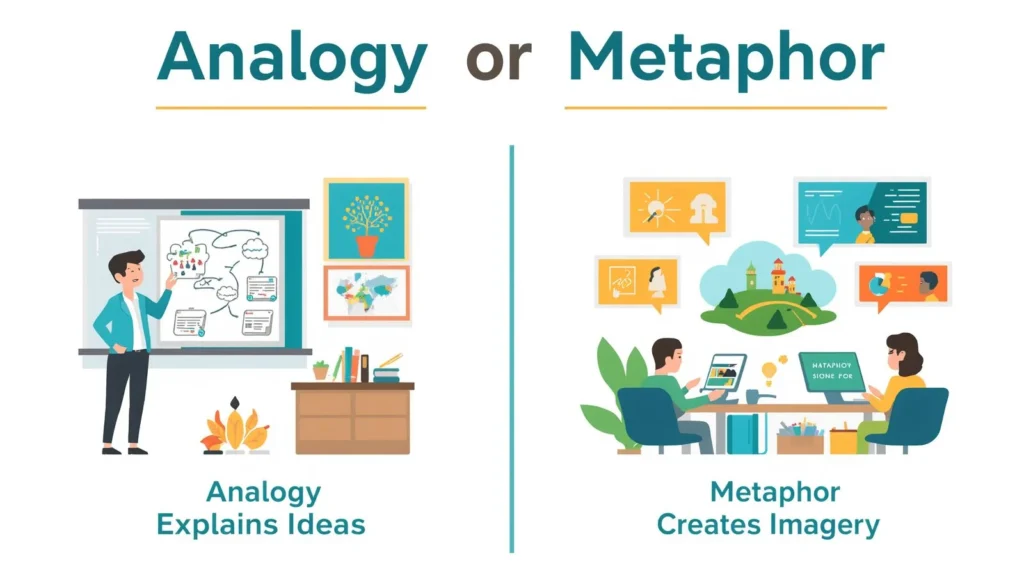
Visual Comparison of Analogy or Metaphor


5
This comparison shows how analogies focus on explanation while metaphors focus on imagery and emotional impact.
How an Analogy Works
An analogy works by comparing relationships.
It helps readers understand unfamiliar ideas using familiar examples.
Example
Learning to drive is like learning to ride a bicycle.
Both require practice, patience, and coordination.
This explanation helps someone understand the learning process.
Another Example
A company is like a machine.
Every department performs a different function, yet all parts work together.
This comparison explains organizational structure.
How a Metaphor Works
A metaphor creates meaning through direct comparison.
Example
The world is a stage.
This does not literally mean the world is a theater stage.
Instead, it suggests people play different roles throughout life.
Another Example
He has a heart of stone.
This metaphor suggests emotional coldness.
It creates a strong image without lengthy explanation.
Why People Confuse Analogy or Metaphor
Many people confuse these devices because both involve comparisons.
Similar Purpose
Both help communicate ideas.
Shared Elements
Both compare one thing to another.
Educational Overlap
Teachers often discuss them together.
Writing Usage
Both appear frequently in literature and speeches.
Despite these similarities, their goals are different.
Analogy in Education
Teachers frequently use analogies.
Complex subjects become easier to understand through familiar comparisons.
Examples:
- Electricity flowing through wires is like water flowing through pipes.
- The solar system is like a family with the sun at the center.
These comparisons simplify difficult concepts.
Metaphor in Literature
Metaphors are common in poems, novels, and speeches.
Writers use them to create emotion and imagery.
Examples:
- The city was a jungle.
- Fear was a shadow following him.
These statements paint vivid mental pictures.
Second Visual Comparison Section


6
Analogies simplify learning, while metaphors enhance creativity and emotional expression.
Real World Examples of Analogy
Technology Example
A computer firewall is like a security guard.
Both protect against unwanted access.
Sports Example
Building a championship team is like building a house.
A strong foundation is essential.
Business Example
Managing money is like maintaining a garden.
Regular attention produces healthy growth.
Real World Examples of Metaphor
Business Example
The company is a rocket ship.
Sports Example
The athlete was a machine.
Education Example
Knowledge is a key.
Personal Growth Example
Life is a marathon.
These metaphors create strong mental images.
Advantages of Using Analogies
Easier Understanding
Complex ideas become simpler.
Better Learning
Students remember information more easily.
Improved Communication
Concepts become clearer.
Effective Teaching
Teachers can explain difficult topics efficiently.
Advantages of Using Metaphors
Strong Imagery
Readers visualize ideas.
Emotional Impact
Messages become memorable.
Creative Writing
Stories become more engaging.
Persuasive Communication
Speeches become more powerful.
Disadvantages of Analogies
Can Be Too Long
Some analogies require detailed explanations.
Potential Oversimplification
Important details may be lost.
Misleading Comparisons
Poor analogies can confuse readers.
Disadvantages of Metaphors
Can Be Misinterpreted
Readers may misunderstand meaning.
Less Precise
Metaphors often focus on imagery rather than explanation.
Cultural Differences
Some metaphors may not translate well across cultures.
Common Mistakes When Using Analogy or Metaphor
Mistake One
Using a metaphor when explanation is needed.
Correction:
Use an analogy for teaching or clarification.
Mistake Two
Writing overly complicated analogies.
Correction:
Keep comparisons simple.
Mistake Three
Mixing unrelated metaphors.
Correction:
Maintain consistent imagery.
Mistake Four
Assuming all comparisons are metaphors.
Correction:
Some comparisons are analogies.
Related Literary Devices
Several literary devices are related to analogy and metaphor.
Simile
Uses like or as.
Example:
- Busy as a bee.
Allegory
A story with symbolic meaning.
Personification
Giving human traits to nonhuman things.
Symbolism
Using objects to represent ideas.
Third Visual Comparison Section


4
Understanding related literary devices helps writers communicate more effectively.
Analogy vs Metaphor in Academic Writing
Academic writing often prefers analogies because clarity is important.
Examples:
- Explaining scientific concepts
- Teaching mathematics
- Describing economic systems
Analogies help readers understand information accurately.
Analogy vs Metaphor in Creative Writing
Creative writing frequently relies on metaphors.
Examples:
- Novels
- Poetry
- Short stories
- Speeches
Metaphors make language more vivid and expressive.
Historical Use of Analogies
Analogies have been used for centuries.
Ancient philosophers used analogies to explain logic, ethics, and science.
Teachers continue using them today because they simplify learning.
Historical Use of Metaphors
Metaphors have existed throughout literary history.
Many famous writers and poets relied heavily on metaphors to express complex emotions.
Classic literature contains thousands of memorable metaphorical expressions.
Regional and Global Usage
Analogy and metaphor are used worldwide.
They appear in:
- English literature
- Journalism
- Education
- Business communication
- Public speaking
Although examples vary between cultures, the concepts remain the same.
Beginner to Advanced Understanding
Beginner Level
An analogy explains.
A metaphor illustrates.
Intermediate Level
Analogies compare relationships.
Metaphors compare identities.
Advanced Level
Writers strategically choose between analogy and metaphor depending on audience, purpose, and communication goals.
Professional Writing Applications
Professionals use both devices.
Business
Analogies explain strategies.
Marketing
Metaphors create memorable slogans.
Education
Analogies improve understanding.
Public Speaking
Metaphors increase emotional engagement.
Exercises With Answers
Question One
Which device explains an idea?
Answer: Analogy
Question Two
Which device creates imagery?
Answer: Metaphor
Question Three
Is “Life is a journey” a metaphor?
Answer: Yes
Question Four
Is comparing the brain to a computer an analogy?
Answer: Yes
Question Five
Which device is usually longer?
Answer: Analogy
Question Six
Which device is common in poetry?
Answer: Metaphor
Question Seven
Which device helps students understand complex topics?
Answer: Analogy
Question Eight
Can writers use both in the same text?
Answer: Yes
Question Nine
Which device focuses on explanation?
Answer: Analogy
Question Ten
Which device focuses on imagery?
Answer: Metaphor
Frequently Asked Questions
What is the difference between analogy and metaphor?
An analogy explains relationships, while a metaphor creates imagery.
Is every metaphor an analogy?
No. Metaphors and analogies serve different purposes.
Can an analogy contain a metaphor?
Yes. Some analogies include metaphorical elements.
Which is better for teaching?
Analogies are usually better for explanation.
Which is better for storytelling?
Metaphors are often more effective.
Why do writers use metaphors?
To create vivid imagery and emotional impact.
Why do teachers use analogies?
To simplify complex ideas.
Can a sentence be both an analogy and a metaphor?
In some contexts, elements of both may appear together.
Are metaphors used in everyday speech?
Yes, very frequently.
Do analogies improve learning?
Yes. They help connect new information to familiar concepts.
Conclusion
Understanding analogy or metaphor is essential for effective communication, writing, and learning. Although both involve comparisons, they serve different purposes. An analogy explains a concept by comparing it to something familiar, making complex ideas easier to understand. A metaphor creates imagery and emotional meaning by directly comparing two unlike things.
Writers, teachers, students, marketers, and public speakers regularly use both devices. Analogies help explain difficult subjects such as science, technology, and business. Metaphors enhance creativity, strengthen emotional impact, and make writing more memorable.
The easiest way to remember the difference is this: analogies teach, while metaphors paint pictures. By choosing the right device for the right situation, you can improve clarity, engagement, and overall communication. Whether you are writing an essay, delivering a speech, or creating content, understanding analogy or metaphor will make your language more powerful and effective.