
Quick Answer
Lose and loss are both correct English words, but they have different meanings and grammar roles. Lose is a verb that means to fail to keep, misplace, or be defeated. Loss is a noun that refers to something that has been lost or the act of losing.
Many English learners confuse lose or loss because the words look similar and have related meanings. They are also pronounced differently, which makes spelling even more confusing. As a result, students, bloggers, professionals, and native English speakers sometimes use the wrong word in emails, essays, social media posts, and business documents.
The good news is that the difference is easy to understand. Lose is an action word. It describes what someone does when they no longer have something or when they fail in a competition. Loss, however, is a thing or result. It refers to the condition of no longer having something valuable or important.
Learning the correct use of lose or loss improves your grammar, writing, and communication skills. You are preparing for an English exam, writing professional content, or improving everyday conversations, understanding these two words will help you write with confidence.
This complete guide explains lose or loss with simple definitions, grammar rules, comparison tables, examples, common mistakes, real life situations, exercises, and frequently asked questions.
Quick Overview
Lose is a verb.
Loss is a noun.
Lose means to misplace, fail to keep, or be defeated.
Loss means something that has been lost or the result of losing.
Both words are correct when used in the proper context.
Key Difference Between Lose or Loss
| Feature | Lose | Loss |
|---|---|---|
| Part of Speech | Verb | Noun |
| Meaning | To fail to keep or to be defeated | Something lost or the result of losing |
| Action Word | Yes | No |
| Thing or Result | No | Yes |
| Everyday Usage | Very Common | Very Common |
| Professional Writing | Yes | Yes |
The easiest way to remember the difference is simple.
Lose is something you do.
Loss is something you experience.
What Does Lose Mean
Lose is a verb.
It means to no longer have something, fail to win, or become separated from something.
Examples
I do not want to lose my keys.
Our team may lose the match.
She does not want to lose her job.
Be careful not to lose your passport.
In every example, lose describes an action.
What Does Loss Mean
Loss is a noun.
It refers to something that has been lost or the result of losing.
Examples
The company reported a financial loss.
The loss of electricity caused delays.
His family felt a great loss.
Weight loss takes time and patience.
In each sentence, loss is a thing, not an action.
Visual Comparison of Lose or Loss
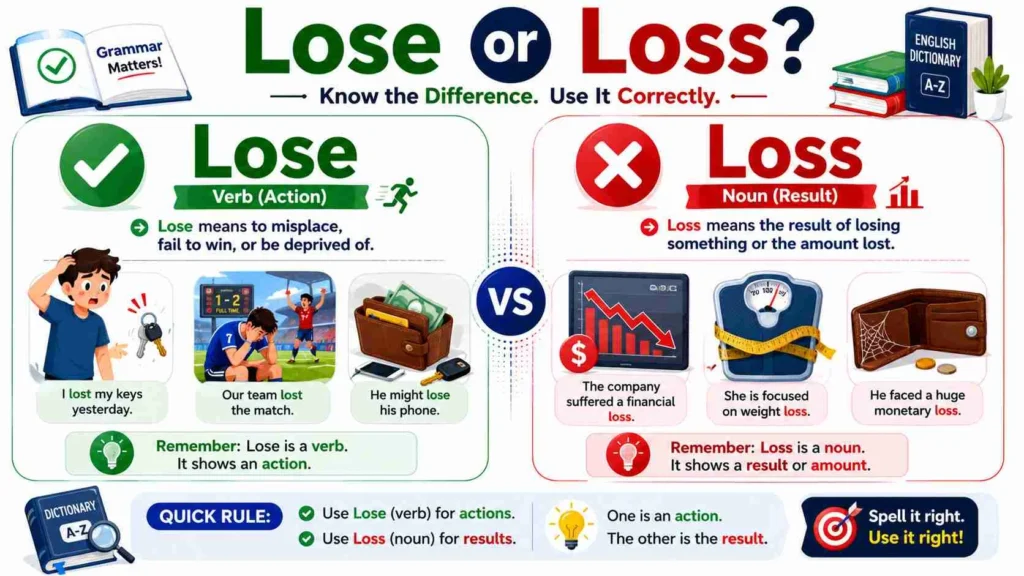
Image Prompt 1600 by 900
Create a professional educational comparison image titled Lose or Loss. Use a clean white background. Show Lose on the left with a person dropping keys and a green check mark labeled Verb Action Word. Show Loss on the right with an empty wallet, declining business chart, and a green check mark labeled Noun Result. Add grammar books, dictionary icons, and use a modern flat infographic style with a 1600 by 900 ratio.
Grammar Rules for Lose or Loss
Understanding the grammar difference makes choosing the correct word much easier.
Use lose when describing an action.
Correct
Do not lose your phone.
Incorrect
Do not loss your phone.
Use loss when referring to a result or condition.
Correct
The business suffered a loss.
Incorrect
The business suffered a lose.
Simple Rule
Lose equals action.
Loss equals result.
Verb Forms of Lose
Like many English verbs, lose changes form depending on the tense.
| Verb Form | Word |
|---|---|
| Base Verb | Lose |
| Simple Past | Lost |
| Past Participle | Lost |
| Present Participle | Losing |
Examples
I lose my focus sometimes.
Yesterday I lost my wallet.
I have lost my phone.
She is losing confidence.
Notice that loss never appears as a verb.
Why People Confuse Lose or Loss
Several reasons explain the confusion.
The words have similar spelling.
Both relate to not having something.
English pronunciation differs from spelling.
Many learners memorize only one form.
Typing quickly increases spelling mistakes.
Fortunately, the grammar rule is easy to remember.
Lose is an action.
Loss is a result.
Everyday Examples
School
Do not lose your homework.
Business
The company suffered a huge loss.
Sports
Our team may lose tonight.
Health
Weight loss requires regular exercise.
Travel
Do not lose your boarding pass.
Finance
The investor accepted a small loss.
Visual Examples in Everyday Life
Image Prompt 1600 by 900
Create a professional educational infographic showing everyday examples of Lose and Loss. Include a student losing books, an athlete losing a game, a business showing financial loss, and a person achieving weight loss. Use a clean white background, flat modern icons, balanced layout, and a 1600 by 900 ratio.
Lose or Loss in Business
Businesses often use both words.
Examples of lose
The company could lose customers.
The store may lose money.
Examples of loss
The company reported a financial loss.
The business experienced a loss in sales.
Understanding this difference is important in accounting, finance, and management.
Lose or Loss in Sports
Lose is used when a team is defeated.
Example
Our team did not want to lose the final.
Loss is used when talking about the result.
Example
The championship loss disappointed the fans.
Lose or Loss in Health
Doctors often use the word loss.
Examples
Weight loss.
Hearing loss.
Memory loss.
Hair loss.
However, lose is also common.
Examples
Many people want to lose weight.
He hopes to lose ten kilograms.
Advantages of Understanding Lose or Loss
Improves grammar.
Strengthens writing.
Builds confidence.
Avoids common mistakes.
Helps students score better.
Improves professional communication.
Makes business writing more accurate.
Common Mistakes
Mistake One
I do not want to loss my phone.
Correction
I do not want to lose my phone.
Mistake Two
The company reported a lose.
Correction
The company reported a loss.
Mistake Three
She experienced a lose of confidence.
Correction
She experienced a loss of confidence.
Mistake Four
We may loss the match.
Correction
We may lose the match.
Mistake Five
His weight lose was impressive.
Correction
His weight loss was impressive.
Related Grammar Comparisons
Affected or Effected
Advice or Advise
Accept or Except
Flown or Flew
Which or Witch
Dialogue or Dialog
Email or Mail
Foolproof or Fullproof
These word pairs are commonly confused because they look or sound similar.
Third Educational Image
Image Prompt 1600 by 900
Create a professional educational comparison infographic titled Lose or Loss. Show correct example sentences with green check marks and incorrect sentences with red correction symbols. Include dictionaries, grammar books, sports trophies, financial charts, and weight scale icons. Use a clean white background with a modern flat infographic style.
Beginner to Advanced Understanding
Beginner Level
Lose is a verb.
Loss is a noun.
Intermediate Level
Use lose for actions.
Use loss for results.
Advanced Level
Professional writers carefully distinguish between lose and loss because confusing these words changes sentence meaning and reduces writing quality.
Regional and Global Usage
The words lose and loss are used the same way in American English, British English, Canadian English, Australian English, and international English.
Unlike words such as color and colour, there is no regional spelling difference.
The grammar rules remain exactly the same worldwide.
Real World Examples
Example One
A traveler may lose a passport during a trip.
Example Two
The airline compensated passengers for luggage loss.
Example Three
A business may lose customers after poor service.
Example Four
The company reported a significant financial loss.
Example Five
Many people exercise to lose weight.
Example Six
Weight loss improves overall health when combined with healthy eating.
Exercises With Answers
Question One
Which word is a verb
Answer
Lose
Question Two
Which word is a noun
Answer
Loss
Question Three
Complete the sentence.
Do not ______ your wallet.
Answer
Lose
Question Four
Complete the sentence.
The company suffered a huge ______.
Answer
Loss
Question Five
Which sentence is correct
I may lose my keys.
Question Six
Which sentence is correct
The storm caused major property loss.
Question Seven
Can loss be used as a verb
Answer
No
Question Eight
Can lose describe an action
Answer
Yes
FAQs
Is lose or loss correct
Both are correct, but they have different meanings and grammar functions.
What is the difference between lose and loss
Lose is a verb, while loss is a noun.
How do I remember the difference
Remember that lose is an action and loss is the result.
Can I say loss my phone
No. The correct sentence is lose my phone.
Can I say financial lose
No. The correct phrase is financial loss.
Which word is used in weight loss
Loss.
Which word is used in lose weight
Lose.
Is lose more common than loss
Both are common because they serve different grammar purposes.
Do British and American English use these words differently
No. Both varieties follow the same grammar rules.
Why do people confuse lose and loss
Because they have similar spelling and related meanings.
Conclusion
Understanding lose or loss is essential for clear and correct English. Lose is a verb that describes the action of no longer having something or being defeated. Loss is a noun that refers to what has been lost or the result of losing. Although the words look similar, they cannot replace each other.
You are writing school assignments, business reports, emails, blog posts, or everyday messages, using the correct word improves your grammar and professionalism. The easiest way to remember the difference is simple. If you are describing an action, use lose. If you are describing the result or condition, use loss. Practicing these rules with real examples will help you use both words confidently in every situation.