

Quick Answer
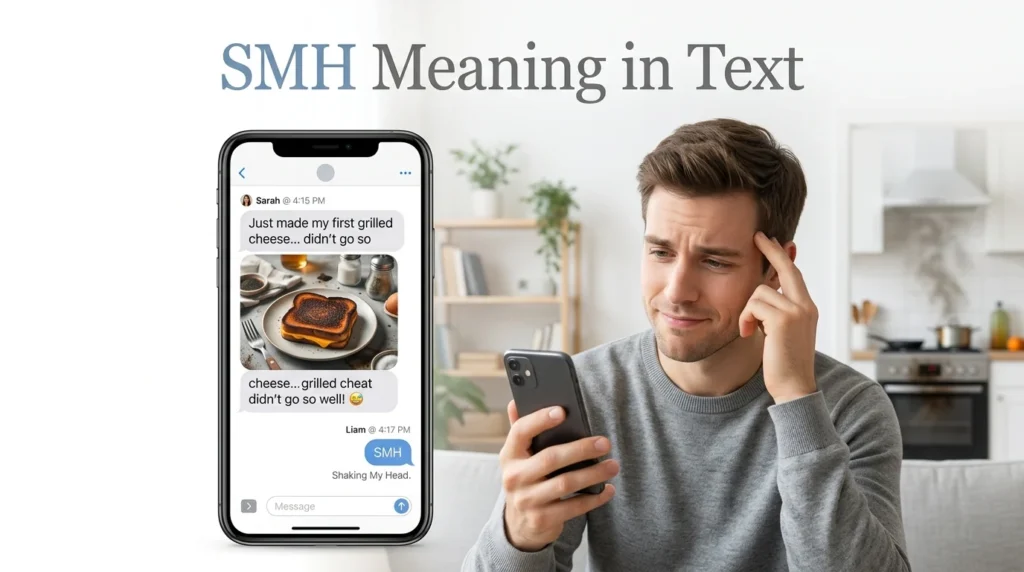
SMH usually means “Shaking My Head” in text messages and online conversations. People use it to show disappointment, disbelief, frustration, embarrassment, or amusement at someone’s words or actions.
The keyword SMH meaning in text refers to the popular abbreviation “Shaking My Head.” People use SMH when something seems foolish, frustrating, surprising, disappointing, or hard to believe. It is a quick way to show a reaction without writing a complete sentence.
For example, if a friend forgets their own birthday plans, you might text, “SMH.” This means that you are shaking your head because the situation seems silly or unbelievable. The phrase can be serious, playful, annoyed, or humorous depending on the conversation.
SMH is common in text messages, social media posts, online comments, group chats, and gaming conversations. Although it is usually informal, understanding its tone helps prevent confusion because the same abbreviation can sound funny in one situation and critical in another.
Key Facts About SMH
| Category | Details |
|---|---|
| Full Meaning | Shaking My Head |
| Type | Texting abbreviation |
| Main Use | Showing disbelief, disappointment, frustration, or amusement |
| Pronunciation | Shaking my head |
| Writing Style | Casual and informal |
| Common Places | Text messages, social media, chats, comments |
| Formal Use | Not recommended in professional writing |
| Typical Tone | Annoyed, disappointed, surprised, amused, or sarcastic |
What Is SMH in Text?
SMH is a short form of “Shaking My Head.” It describes the reaction people often make when they see or hear something foolish, disappointing, strange, or frustrating.
In a text conversation, the sender does not need to explain the entire reaction. Writing “SMH” communicates that they cannot believe what happened or that they are disappointed by someone’s behavior.
For example:
“He forgot to bring the tickets again. SMH.”
This means the person is frustrated or disappointed because someone made the same mistake again.
SMH can also be used when a situation is funny rather than truly upsetting:
“I walked into the wrong classroom and sat down for ten minutes. SMH.”
Here, the abbreviation shows embarrassment and self-amusement.
SMH Meaning in Text
The most common meaning of SMH is “Shaking My Head.”
The expression often communicates one of the following reactions:
- Disbelief
- Disappointment
- Frustration
- Confusion
- Embarrassment
- Annoyance
- Sarcasm
- Amusement
The meaning depends on the context. If someone makes a careless mistake, SMH may show frustration. If someone tells a ridiculous joke, it may show playful disbelief. If a person shares an embarrassing story about themselves, SMH may express humor.
Example of Disbelief
“She thought the moon was a planet. SMH.”
The sender is saying that the statement was surprising or incorrect.
Example of Frustration
“My brother used my laptop and left it with no battery. SMH.”
The sender is annoyed by the situation.
Example of Amusement
“I searched for my glasses while they were on my head. SMH.”
The sender is laughing at their own mistake.
How Is SMH Used in Conversations?
SMH is usually placed at the end of a message, but it can also appear at the beginning or stand alone.
SMH at the End of a Message
This is one of the most common forms.
“You forgot your wallet again. SMH.”
The abbreviation emphasizes the sender’s reaction to the situation.
SMH at the Beginning of a Message
SMH can introduce a frustrated or surprised response.
“SMH, why would you send that message to the whole group?”
This use shows that the sender strongly questions someone’s decision.
SMH as a Complete Reply
Sometimes, a person only writes:
“SMH.”
This short response may mean:
- “I cannot believe you.”
- “That was a bad decision.”
- “What were you thinking?”
- “That is so frustrating.”
- “I am disappointed.”
- “That is funny but ridiculous.”
Because the message is so short, the previous conversation is important for understanding the intended tone.
Examples of SMH in Text Messages
Example 1: Forgetting Something
Alex: I left my keys inside the house again. Sam: SMH.
Sam is expressing mild frustration or amusement.
Example 2: A Silly Mistake
Alex: I spent ten minutes looking for my phone while holding it. Sam: SMH 😂
The response is humorous rather than harsh.
Example 3: Repeated Behavior
Alex: He was late to the meeting for the third time. Sam: SMH. He needs to manage his time.
The abbreviation shows disappointment.
Example 4: A Strange Decision
Alex: She wore winter clothes during a heat wave. Sam: SMH.
The sender finds the decision strange or unreasonable.
Example 5: Personal Embarrassment
Alex: I waved back at someone who was waving at the person behind me. Sam: SMH. That is painful.
The phrase shows secondhand embarrassment.
Example 6: Online Arguments
Alex: People are still arguing about something that happened ten years ago. Sam: SMH.
The sender is expressing disbelief or annoyance.
Example 7: A Funny Accident
Alex: I put my cereal in the fridge and the milk in the cupboard. Sam: SMH 😂
The response shows playful amusement.
Example 8: Disappointing News
Alex: The team lost because the player missed an easy shot. Sam: SMH.
The sender is disappointed by the result.
How to Reply to SMH
Your response depends on whether SMH sounds serious, humorous, or critical.
If Someone Is Joking
You can reply with humor:
- “I know, right?”
- “I cannot explain myself.”
- “My brain stopped working.”
- “Do not judge me.”
- “It happens to the best of us.”
If Someone Is Frustrated
A calm reply may help:
- “I understand why you are annoyed.”
- “I will try not to do it again.”
- “You are right. That was careless.”
- “Sorry about that.”
- “I will fix it.”
If Someone Is Teasing You
You can respond playfully:
- “Relax, it was an accident.”
- “You would have done the same thing.”
- “I am only human.”
- “That was one time.”
- “You are being dramatic.”
If You Do Not Understand the Tone
Ask directly:
“Are you joking or are you actually upset?”
This can prevent a small misunderstanding from becoming a larger problem.
SMH vs Similar Text Abbreviations
Several texting expressions can show frustration, surprise, or disbelief. However, they do not all carry the same meaning.
| Abbreviation or Phrase | Meaning | Main Purpose |
|---|---|---|
| SMH | Shaking My Head | Showing disbelief, frustration, or disappointment |
| SMDH | Shaking My Damn Head | Stronger frustration or disbelief |
| WTF | What the Heck or a stronger phrase | Showing shock, confusion, or anger |
| OMG | Oh My God | Showing surprise or excitement |
| LOL | Laughing Out Loud | Showing amusement |
| NGL | Not Gonna Lie | Introducing an honest statement |
| TBH | To Be Honest | Sharing an honest opinion |
| FR | For Real | Showing agreement or emphasis |
| IDK | I Do Not Know | Expressing uncertainty |
SMH and SMDH
SMH means “Shaking My Head.” SMDH usually means “Shaking My Damn Head.” The added word makes SMDH stronger and more emotional.
For example:
“He forgot the appointment again. SMH.”
This shows frustration.
“He forgot the appointment again. SMDH.”
This suggests stronger annoyance or disbelief.
Is SMH Formal or Informal?
SMH is an informal texting abbreviation. It works well in casual conversations with friends, family members, classmates, and online communities.
You may see SMH in:
- Text messages
- Instagram comments
- TikTok comments
- Facebook posts
- Snapchat chats
- Online gaming
- Group messages
- Discussion forums
- Direct messages
However, SMH is not suitable for most professional or academic writing. Avoid using it in:
- Business emails
- Job applications
- School assignments
- Official reports
- Customer service messages
- Formal letters
- Workplace documents
Instead of writing:
“SMH, the report was late again.”
A professional version would be:
“I am disappointed that the report was submitted late again.”
The complete sentence communicates the concern more clearly.
Can SMH Sound Rude?
Yes, SMH can sound rude or judgmental in certain situations. The abbreviation often suggests that the sender believes someone has made a foolish, careless, or disappointing choice.
Friendly Use
Between close friends, SMH may be harmless teasing.
“You put your shirt on backward again. SMH 😂”
The emoji makes the message sound playful.
Serious Use
In a serious discussion, SMH may show genuine disappointment.
“You ignored the safety instructions. SMH.”
This sounds more critical.
Sarcastic Use
SMH may also be used to mock an opinion or action.
“He says he never studies, but he still expects the highest grade. SMH.”
The sender is criticizing what they see as an unreasonable expectation.
If you want to avoid sounding too harsh, add context:
- “SMH, but I hope everything works out.”
- “SMH 😂 I am only joking.”
- “I cannot believe that happened.”
- “That was a little frustrating.”
Common Mistakes With SMH
Mistake 1: Thinking SMH Always Means Anger
SMH does not always show anger. It may express amusement, embarrassment, confusion, or mild disappointment.
Mistake 2: Using SMH Without Context
A single “SMH” can be difficult to understand. The other person may not know whether you are joking or criticizing them.
Mistake 3: Confusing SMH With SMDH
SMH means “Shaking My Head.” SMDH usually adds stronger emphasis through the word “damn.” The two expressions are similar but not identical.
Mistake 4: Using SMH in Formal Writing
SMH is internet slang. Use clear, complete sentences in professional and academic settings.
Mistake 5: Assuming Everyone Knows the Abbreviation
Some people may not understand SMH. If the recipient seems confused, write the full phrase.
Mistake 6: Using SMH to Dismiss Someone’s Feelings
A message such as “SMH” may seem disrespectful when someone is discussing a serious problem. Consider the person’s feelings before using it.
Is SMH Used on Social Media?
Yes, SMH is very common on social media. People use it in comments, captions, replies, and posts when reacting to surprising, frustrating, or ridiculous situations.
For example:
“Someone left their shopping cart in the middle of the parking lot.”
A comment might say:
“SMH.”
The commenter is showing annoyance at the careless behavior.
Another example is:
“I accidentally sent a private message to the family group.”
A friend might reply:
“SMH 😂”
This response expresses amusement and embarrassment.
On social media, punctuation and emojis can change the tone:
- SMH can sound serious or disappointed.
- SMH 😂 usually sounds humorous.
- SMH 🙄 may express annoyance or sarcasm.
- SMH… may suggest disappointment or disbelief.
- SMH, seriously? sounds more critical.
Is SMH Used in Gaming and Online Communities?
SMH is also common in gaming chats and online communities. Players may use it when someone makes a poor decision, misses an easy opportunity, or repeats the same mistake.
For example:
“Our teammate ran into the enemy team alone. SMH.”
The sender is expressing frustration with the teammate’s decision.
It may also be used in a lighthearted way:
“I lost because I forgot to reload. SMH.”
In this case, the player is making fun of their own mistake.
The meaning remains the same, but the tone depends on the group and the situation.
Other Possible Meanings of SMH
In most casual text conversations, SMH means “Shaking My Head.” However, abbreviations can have different meanings in specialized settings.
SMH may sometimes appear as part of a business name, organization name, username, technical term, or other title. These meanings are less likely when someone sends SMH in a casual chat.
If the abbreviation appears alone in a text message or social media comment, “Shaking My Head” is usually the correct interpretation.
Always consider the surrounding words, the subject of the conversation, and the relationship between the people involved.
FAQs
1. What does SMH mean in text messages?
SMH usually means “Shaking My Head.” It expresses disbelief, frustration, disappointment, embarrassment, or amusement.
2. Is SMH a bad word?
No. SMH is not a bad word. It is a casual abbreviation that describes a reaction to something surprising, foolish, frustrating, or disappointing.
3. Can SMH be used as a joke?
Yes. People often use SMH humorously when someone makes a silly mistake or tells an embarrassing story about themselves.
4. Does SMH mean someone is angry?
Not always. SMH can show anger, but it may also express mild annoyance, disbelief, confusion, embarrassment, or playful teasing.
5. What is the difference between SMH and SMDH?
SMH means “Shaking My Head.” SMDH usually means “Shaking My Damn Head” and expresses stronger frustration or disbelief.
6. Is SMH appropriate for professional messages?
Generally, no. SMH is informal internet slang. In professional communication, use a complete phrase such as “I am disappointed” or “I cannot believe this happened.”
7. How should I reply to someone who texts SMH?
You can reply with “I know, right?”, “Sorry about that,” or “I was only joking.” The best response depends on whether the sender is teasing, upset, or expressing disbelief.
8. Can SMH sound rude?
Yes. SMH may sound judgmental when used during a serious discussion or directed at someone who feels upset. Context and tone are important.
Conclusion
SMH usually means “Shaking My Head” in text messages and online conversations. People use it to express disbelief, frustration, disappointment, embarrassment, sarcasm, or amusement.
The abbreviation is common in casual chats and social media, but it may sound rude if the context is unclear. Use it with people who understand texting slang, and choose complete sentences in formal communication.