
Quick Answer
Smash or pass is an informal internet slang phrase used as a quick choice about whether someone is sexually attractive or whether the person making the choice would be interested in them. Smash indicates interest, while pass means no or not interested.
If you spend time on social media, YouTube, memes, or online conversations, you may have seen the phrase smash or pass. At first, the expression can sound confusing because the normal meaning of smash has nothing to do with attraction. In slang, however, the word has a different meaning.
Smash or pass is usually presented as a simple two-choice game or question. Someone shows a person, celebrity, fictional character, or sometimes another subject and asks for a quick reaction. The phrase is casual, blunt, and often humorous.
Still, context matters. The expression has a sexual meaning when it is used about people. Because of that, it is not suitable for every situation. Understanding what the phrase means can help you recognize it in online conversations without using it in the wrong setting.
What Does Smash or Pass Mean?
Smash or pass is an informal slang expression that asks someone to choose between two options.
In its original and most common use involving people:
- Smash means the person is considered sexually attractive or someone the speaker would be interested in having sex with.
- Pass means the person is not considered attractive enough for that choice, or the speaker is not interested.
For example:
“That celebrity? Smash or pass?”
The person answering is being asked to make a quick judgment.
The phrase is usually used casually and is not appropriate for formal communication.
What Does Smash Mean in Slang?
The word smash has several meanings in English.
In ordinary English, smash can mean to break something violently or into pieces.
For example:
He smashed the old phone.
However, smash has another meaning in informal slang. In smash or pass, it refers to sexual interest.
That is why the phrase can seem confusing to someone who only knows the standard dictionary meaning of smash.
The context tells you which meaning is intended.
What Does Pass Mean in Smash or Pass?
Pass is the easier part of the expression.
In this context, pass means choosing not to participate in the sexual or romantic interest being suggested.
For example:
“That character?”
“Pass.”
The answer means the speaker is not interested.
The word pass already has many meanings in everyday English. You can pass a test, pass someone on the road, pass an object to another person, or pass on an opportunity. In smash or pass, it simply signals rejection or a decision not to choose the option.
Is Smash or Pass a Correct Phrase?
Yes. Smash or pass is a recognized informal slang phrase.
It is not formal vocabulary, though. You would not normally use it in a business email, academic paper, job application, or professional report.
The phrase belongs to casual internet language.
You may see it written as:
Smash or pass?
or:
Would you smash or pass?
Both forms are understandable in casual conversation.
Smash or Pass vs Smash and Pass
The standard expression is:
smash or pass
The word or is important because the phrase presents a choice between two alternatives.
For example:
Smash or pass?
means:
Which option would you choose?
The phrase smash and pass is not the standard name of this game or expression. Replacing or with and changes the structure and can create a different meaning.
So, when referring to the internet trend, use smash or pass.
How Is Smash or Pass Used Online?
The phrase became widely associated with online videos, memes, social media posts, and casual challenges.
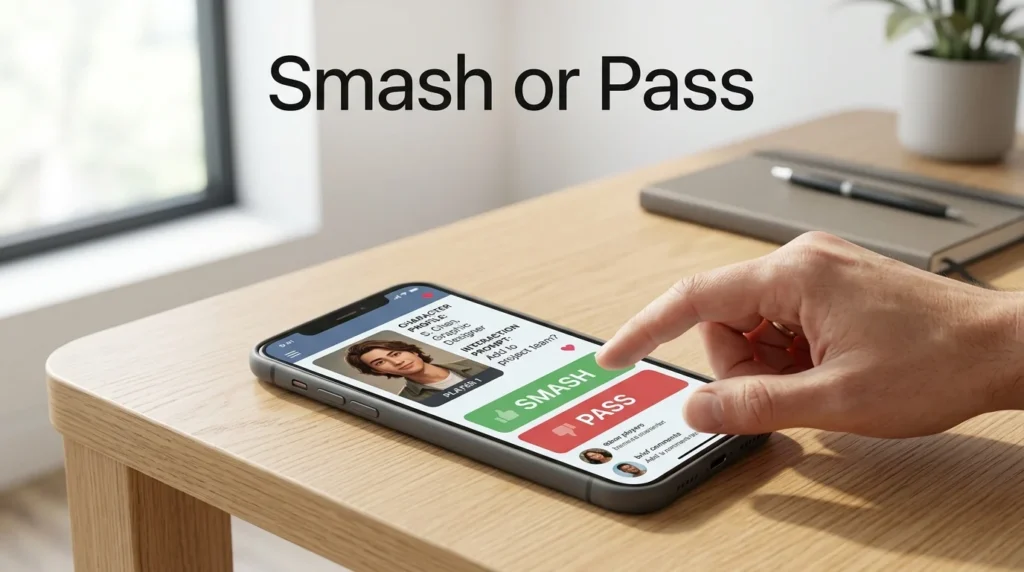
A typical format shows a person or character and asks viewers to choose smash or pass.
For example:
“Round one: fictional superheroes. Smash or pass?”
The audience then reacts.
Some people answer with only one word:
“Smash.”
Others explain their choice:
“Pass. Not my type.”
The format works because it is quick and easy to understand.
Smash or Pass With Celebrities
Celebrities are common subjects in this type of content.
Someone might show a celebrity photo and ask:
“Smash or pass?”
The people playing then give their reactions.
Because celebrities are public figures, this kind of discussion is often presented as a hypothetical game. Even so, the phrase remains sexual in its traditional meaning.
That distinction matters when interpreting comments or videos online.
Smash or Pass With Fictional Characters
The phrase is also used with fictional characters.
For example:
“Batman: smash or pass?”
or:
“Which movie character would you smash or pass?”
This use is usually meant as a playful internet game. The characters may come from movies, television shows, video games, comics, or animation.
In this context, the phrase can be less personal because the subject is fictional.
Can Smash or Pass Be Used for Things?
Yes. Internet users sometimes extend the phrase beyond its original meaning.
People may jokingly use smash or pass for:
- Food
- Cars
- Outfits
- Movies
- Songs
- Vacation destinations
- Video games
- Designs
- Trends
For example:
“This new burger looks amazing. Smash or pass?”
Here, smash does not necessarily carry the sexual meaning. It can simply mean yes, I like it or I approve.
Context is important.
When the subject is a person, especially in a social media setting, the sexual meaning is usually the first interpretation.
Is Smash or Pass a Dating Phrase?
It can be connected to dating and attraction, but its traditional meaning is more sexual than simply asking whether someone would date a person.
For example, smash or pass is not exactly the same as:
“Would you date this person?”
Dating involves a broader idea of romantic interest.
Smash or pass is usually much more direct and focused on physical or sexual attraction.
That difference is useful when interpreting the phrase in online conversations.
Is Smash or Pass Rude?
It can be.
The answer depends heavily on the situation, the people involved, and how the phrase is used.
Using the phrase among friends in a clearly playful context may be treated as ordinary internet humor.
However, publicly rating real people based on sexual attractiveness can make people uncomfortable. It can also feel disrespectful, especially when the person being discussed did not agree to participate.
So, although the phrase is common online, common does not always mean appropriate.
Why Context Matters
Internet slang often changes meaning depending on the situation.
Consider these two examples:
“Smash or pass: this fictional character?”
This is clearly a casual game involving a fictional person.
Now consider:
“Smash or pass: that person from our class.”
That situation can be much more uncomfortable because it involves a real person who may not want to be discussed in sexual terms.
The phrase itself has not changed. The social context has.
That is why understanding slang involves more than knowing the dictionary meaning.
Smash or Pass in Text Messages
You may see the phrase in texts and direct messages.
For example:
“Okay, quick question. Smash or pass?”
Or:
“I have a list. Smash or pass?”
A person may also shorten the response:
“Smash.”
or:
“Pass.”
These are very casual messages.
Because the phrase has a sexual meaning, it should not be used casually with people who may not be comfortable with that type of conversation.
Smash or Pass on Social Media
Social media helped make the phrase widely recognizable.
It can appear in:
- Video titles
- Comment sections
- Polls
- Memes
- Short videos
- Livestreams
- Group chats
A creator might make a video around a particular theme and ask viewers to choose between the two options.
The format is simple, which makes it easy for viewers to understand and respond to.
Common Examples of Smash or Pass
Here are some clean examples that show how the phrase works:
“Smash or pass?”
“That actor? Smash.”
“Pass. Not my type.”
“Let’s play smash or pass with fictional characters.”
“The video asks viewers to choose smash or pass.”
“He immediately said pass.”
These examples demonstrate the phrase without needing graphic language.
Common Mistakes With Smash or Pass
One common mistake is thinking that smash always means physically breaking something.
That is true in ordinary contexts, but not in this slang expression.
Another mistake is replacing or with and.
The common phrase is:
smash or pass
not:
smash and pass
A third mistake is assuming that smash or pass always refers to dating.
Its traditional slang meaning is more directly related to sexual attraction.
A fourth mistake is using the phrase in a formal setting. It is casual internet slang and does not belong in most professional or academic writing.
Smash or Pass vs Would You Date?
These expressions are related, but they are not identical.
Smash or pass usually asks about sexual attraction.
Would you date this person? asks about romantic or relationship interest.
For example:
“Would you date her?”
focuses on dating.
But:
“Smash or pass?”
usually has a more sexual meaning.
This difference becomes especially important when translating or explaining slang to someone who is unfamiliar with it.
Smash or Pass vs Hot or Not
Hot or not is another expression associated with judging someone’s physical attractiveness.
However, the tone is different.
Hot or not usually asks whether someone is attractive.
Smash or pass takes the idea further by using sexual slang.
Both phrases can appear in casual online conversations, but they do not carry exactly the same tone.
Is Smash or Pass Formal English?
No.
Smash or pass is informal slang.
Avoid it in:
- Academic essays
- Business reports
- Professional emails
- Job applications
- Formal presentations
- Official documents
Instead, use clearer language that matches the situation.
For example, instead of:
“Would you smash or pass?”
a formal discussion might say:
“Would you consider this person attractive?”
The second sentence is much more appropriate for a serious setting.
How to Understand Smash or Pass in a Conversation
When you see smash or pass, first look at the subject.
If the subject is a person or fictional character, the phrase probably carries its traditional sexual meaning.
If the subject is food, a product, a car, or another object, it may simply be playful slang for like or skip.
The surrounding conversation can also help.
For example:
“New pizza flavor. Smash or pass?”
Here, the phrase is clearly being used humorously.
On the other hand:
“Celebrity crush. Smash or pass?”
has the traditional attraction-based meaning.
Is Smash or Pass Appropriate for Everyone?
Not necessarily.
Because the phrase has a sexual meaning, it is best kept within appropriate adult conversations.
It is also important to avoid using the phrase to pressure someone into making a sexual judgment about another person.
If someone does not want to play or answer, they can simply decline.
Respect matters more than the game.
A Simple Way to Remember the Meaning
You can remember the phrase as a two-option choice:
Smash = interested
Pass = not interested
However, remember that smash is slang here. It does not have its normal meaning of breaking something.
Also remember that the phrase is informal and often sexual when used about people.
Practice Questions
Try to identify what smash or pass means in each example.
1. “Smash or pass: this new pizza?”
What does it most likely mean?
Answer: Like it or skip it. The phrase is being used humorously about food.
2. “Smash or pass: that celebrity?”
What does it most likely mean?
Answer: A choice based on sexual attraction.
3. “Is smash or pass formal English?”
Answer: No. It is informal internet slang.
4. “Can smash or pass refer to fictional characters?”
Answer: Yes. It is often used in playful online discussions about fictional characters.
5. “Does smash always mean break something?”
Answer: No. In this phrase, smash is slang with a different meaning.
Final Tips
Keep these points in mind:
- Smash or pass is the standard phrase.
- It is informal internet slang.
- Smash can indicate sexual interest in this context.
- Pass means choosing not to.
- The phrase is usually presented as a quick two-choice question.
- It can also be used jokingly for fictional characters or objects.
- Smash or pass is not suitable for formal writing.
- The meaning depends heavily on context.
- Using the phrase about real people can be uncomfortable or disrespectful.
- Smash or pass and would you date do not mean exactly the same thing.
FAQs
What does smash or pass mean in texting?
In texting, smash or pass usually asks whether someone finds a person sexually attractive or would be interested in a sexual encounter. It is informal slang.
What does smash mean in smash or pass?
In this slang phrase, smash indicates sexual interest. It is different from the ordinary meaning of smash, which can mean to break something forcefully.
What does pass mean in smash or pass?
Pass means choosing not to participate or showing that you are not interested in the person or option being discussed.
Is smash or pass a bad word?
It is not normally treated as a swear word, but it is sexual slang. Because of its meaning, it can be inappropriate or disrespectful in certain situations.
Can smash or pass be used for things other than people?
Yes. People sometimes use it jokingly for food, cars, fictional characters, movies, outfits, or other things. In those cases, smash can simply mean approval or liking, depending on the context.
Conclusion
Smash or pass is an informal internet slang phrase built around a simple two-choice question. When it is used about people, smash usually indicates sexual attraction or interest, while pass means choosing not to.
The phrase has become common in online conversations, videos, memes, and social media challenges. However, it is still casual slang and is not suitable for formal writing. Its meaning can also change slightly when people use it jokingly for food, fictional characters, products, or other subjects.
The easiest way to remember it is simple: smash means yes or interested, while pass means no or not interested. Always consider the context, especially when real people are involved.