
Many people search for proof or evidence because the two words are often used interchangeably. In everyday conversations, news reports, scientific discussions, legal cases, and academic writing, people frequently confuse these terms. Although they are related, they have different meanings and purposes.
Understanding proof or evidence is important because using the wrong word can change the meaning of a statement. For example, evidence may suggest that something happened, but proof shows that it definitely happened. This distinction is especially important in law, science, journalism, research, and critical thinking.
Imagine a detective investigating a crime. Fingerprints, witness statements, and surveillance footage are evidence. When all the evidence strongly confirms what happened, it may become proof. Similarly, in science, researchers gather evidence through experiments before reaching conclusions that may eventually become proof.
This guide explains proof or evidence in simple language. You will learn definitions, differences, examples, legal and scientific applications, common mistakes, exercises with answers, and frequently asked questions.
Quick Overview
Evidence supports a claim.
Proof confirms a claim.
Evidence can be weak or strong.
Proof is considered conclusive.
Evidence comes before proof.
Both are important in reasoning, investigations, science, and law.
Definition of Proof
Proof is information or facts that establish something as true.
When proof exists, there is little or no reasonable doubt about a conclusion.
Examples:
- A signed confession may serve as proof.
- Mathematical proof demonstrates that a theorem is true.
- Official documents may provide proof of identity.
Proof is often viewed as the final confirmation of a claim.
Definition of Evidence
Evidence consists of facts, information, observations, or materials that support a claim.
Evidence helps people reach conclusions.
Examples:
- Witness statements
- Photographs
- Research data
- Scientific observations
- Security footage
Evidence may be strong or weak.
Unlike proof, evidence does not always guarantee certainty.
Key Difference Between Proof or Evidence
The biggest difference is certainty.
Evidence suggests something is true.
Proof establishes that it is true.
Quick Comparison Table
| Feature | Proof | Evidence |
|---|---|---|
| Purpose | Confirms a claim | Supports a claim |
| Certainty | High | Varies |
| Role | Final conclusion | Supporting information |
| Legal Use | Establishes guilt or innocence | Helps build a case |
| Scientific Use | Rarely absolute | Commonly collected |
| Strength | Conclusive | Can be weak or strong |
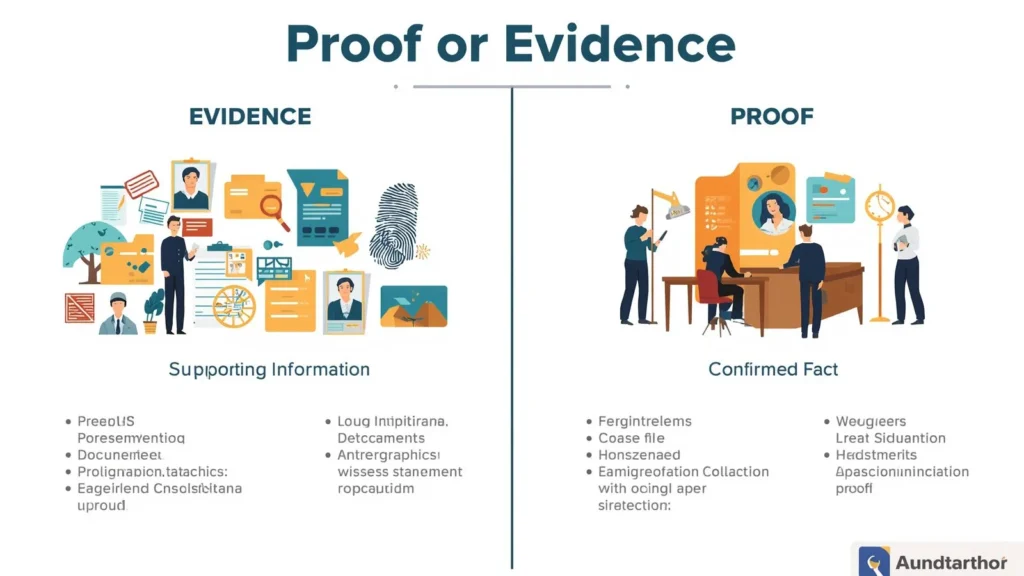
Visual Comparison of Proof or Evidence


4
This comparison shows that evidence supports an argument, while proof provides final confirmation.
Understanding the Relationship Between Proof and Evidence
Proof and evidence work together.
Evidence is usually gathered first.
After enough reliable evidence is collected, it may lead to proof.
Think of building a puzzle.
Each puzzle piece represents evidence.
When all pieces fit together and reveal the complete picture, you have proof.
This analogy helps explain why evidence and proof are related but different.
How Proof Is Used in Everyday Life
People use proof regularly.
Examples include:
- Proof of payment
- Proof of residence
- Proof of age
- Proof of ownership
- Proof of employment
When organizations ask for proof, they want confirmation rather than assumptions.
Examples:
- A passport serves as proof of identity.
- A utility bill may serve as proof of address.
How Evidence Is Used in Everyday Life
Evidence appears in many daily situations.
Examples include:
- A teacher reviewing evidence of plagiarism
- A mechanic examining evidence of engine damage
- A doctor reviewing evidence of illness
- A parent looking for evidence of a broken vase
Evidence helps people make decisions.
However, evidence alone may not always prove something conclusively.
Proof in Mathematics
Mathematics relies heavily on proof.
A mathematical proof demonstrates that a statement is true using logical reasoning.
Examples include:
- Geometric proofs
- Algebraic proofs
- Number theory proofs
Unlike everyday situations, mathematical proof can provide complete certainty.
Once proven correctly, a theorem remains valid.
Evidence in Science
Science primarily relies on evidence.
Scientists collect:
- Experimental data
- Observations
- Measurements
- Research findings
Scientific conclusions are generally based on strong evidence rather than absolute proof.
This is because new discoveries can always provide additional information.
For example:
Scientists have overwhelming evidence that smoking harms health.
Second Visual Comparison Section


4
Science depends on evidence gathered through observation and experimentation, while mathematics often focuses on formal proof.
Proof in Law
Legal systems often distinguish between evidence and proof.
Evidence in Court
Evidence may include:
- Documents
- Witness testimony
- Photographs
- Videos
- Physical objects
Proof in Court
Proof occurs when the evidence convinces a judge or jury of a conclusion.
For example:
A fingerprint is evidence.
Combined with additional evidence, it may become proof of involvement.
Evidence in Criminal Investigations
Investigators gather evidence from many sources.
Common examples include:
- DNA samples
- Security footage
- Witness statements
- Digital records
- Physical traces
The goal is to collect enough evidence to establish proof.
Proof in Academic Writing
Students often confuse proof and evidence.
In academic writing:
Evidence supports arguments.
Examples include:
- Research studies
- Statistics
- Expert opinions
- Historical documents
Strong evidence strengthens essays and research papers.
However, academic arguments usually focus on evidence rather than absolute proof.
Evidence in Journalism
Journalists rely on evidence to verify stories.
Examples include:
- Interviews
- Documents
- Photographs
- Public records
Responsible journalism requires evidence before publishing claims.
Without evidence, information may be considered unreliable.
Types of Evidence
There are many forms of evidence.
Physical Evidence
Objects and materials connected to an event.
Examples:
- Weapons
- Clothing
- Fingerprints
Documentary Evidence
Written records and documents.
Examples:
- Contracts
- Emails
- Receipts
Testimonial Evidence
Statements from witnesses.
Digital Evidence
Information stored electronically.
Examples:
- Text messages
- Computer files
- Social media posts
Types of Proof
Proof can also take different forms.
Mathematical Proof
Uses logic and formulas.
Documentary Proof
Uses official records.
Legal Proof
Establishes facts in court.
Scientific Proof
Strongly supported conclusions based on evidence.
Common Mistakes When Comparing Proof or Evidence
Mistake One
Treating evidence as proof.
Correction:
Evidence supports a claim but may not prove it.
Mistake Two
Assuming one piece of evidence equals proof.
Correction:
Proof often requires multiple supporting pieces of evidence.
Mistake Three
Believing all evidence is equally strong.
Correction:
Some evidence is stronger and more reliable than others.
Mistake Four
Using proof and evidence interchangeably.
Correction:
Although related, they have different meanings.
Real World Examples
Example One
A student claims to have completed homework.
Evidence:
A saved file on a computer.
Proof:
The completed assignment submitted on time.
Example Two
A detective investigates a burglary.
Evidence:
Fingerprints, security footage, and witness statements.
Proof:
A combination of evidence that confirms the suspect’s involvement.
Example Three
A scientist studies climate patterns.
Evidence:
Temperature records and environmental data.
Proof:
A conclusion supported by overwhelming evidence.
Advantages of Understanding the Difference
Better Critical Thinking
People evaluate information more accurately.
Improved Communication
Statements become clearer and more precise.
Stronger Academic Writing
Arguments become more persuasive.
Better Decision Making
Individuals distinguish facts from assumptions.
Disadvantages of Confusing Proof and Evidence
Misunderstandings
People may overstate conclusions.
Weak Arguments
Claims may appear unsupported.
Poor Research Quality
Important distinctions can be overlooked.
Legal Confusion
Incorrect terminology can affect understanding.
Related Concepts and Comparisons
Fact vs Opinion
Facts can be verified.
Opinions reflect personal beliefs.
Data vs Information
Data consists of raw facts.
Information is organized and meaningful.
Theory vs Hypothesis
A hypothesis is a proposed explanation.
A theory is supported by substantial evidence.
Assumption vs Conclusion
Assumptions are made without proof.
Conclusions are reached through evidence.
Third Visual Comparison Section


6
These examples demonstrate how evidence contributes to conclusions that may eventually become proof.
Regional and Global Usage
The meanings of proof and evidence are generally consistent worldwide.
They are used similarly in:
- American English
- British English
- Canadian English
- Australian English
However, legal standards and definitions may vary slightly between countries.
Beginner to Advanced Understanding
Beginner Level
Evidence supports an idea.
Proof confirms an idea.
Intermediate Level
Evidence can be weak or strong.
Proof usually requires strong evidence.
Advanced Level
Different fields apply proof and evidence differently. Mathematics seeks certainty through proof, while science often relies on overwhelming evidence.
Practical Applications
Understanding proof or evidence is valuable in many professions.
Law
Building cases.
Science
Conducting research.
Education
Writing essays.
Journalism
Verifying information.
Business
Making informed decisions.
Healthcare
Diagnosing conditions.
Exercises With Answers
Question One
Which supports a claim?
Answer: Evidence
Question Two
Which confirms a claim?
Answer: Proof
Question Three
Can evidence be weak?
Answer: Yes
Question Four
Does proof usually require strong evidence?
Answer: Yes
Question Five
What do scientists collect?
Answer: Evidence
Question Six
What do mathematicians create?
Answer: Proofs
Question Seven
Can one piece of evidence always provide proof?
Answer: No
Question Eight
Which is more conclusive?
Answer: Proof
Question Nine
Do courts use evidence?
Answer: Yes
Question Ten
Can evidence lead to proof?
Answer: Yes
FAQs
Is proof the same as evidence?
No. Evidence supports a claim, while proof confirms it.
Can evidence become proof?
Yes. Enough strong evidence can establish proof.
What is an example of evidence?
Photographs, documents, and witness statements are examples.
What is an example of proof?
A verified document proving ownership.
Which comes first, proof or evidence?
Evidence comes first.
Do scientists use proof or evidence?
Scientists mainly rely on evidence.
Why is evidence important?
It helps support conclusions and decisions.
Can proof exist without evidence?
Generally, proof is based on evidence.
What is stronger, proof or evidence?
Proof is usually stronger because it establishes certainty.
Why do people confuse proof and evidence?
Because they are closely related and often used together.
Conclusion
Understanding proof or evidence is essential for communication, education, law, science, and everyday decision making. Although the terms are related, they are not identical. Evidence consists of facts, observations, documents, or information that support a claim. Proof is the conclusion reached when evidence is strong enough to establish certainty.
A useful way to remember the difference is that evidence helps build a case, while proof completes it. Detectives gather evidence to solve crimes. Scientists collect evidence to support theories. Students use evidence to strengthen essays. Courts examine evidence to determine proof.
Using these terms correctly improves writing, reasoning, and critical thinking. Whether you are conducting research, evaluating information, or making arguments, understanding the distinction between proof and evidence will help you communicate more accurately and make better informed decisions.