

Quick Answer
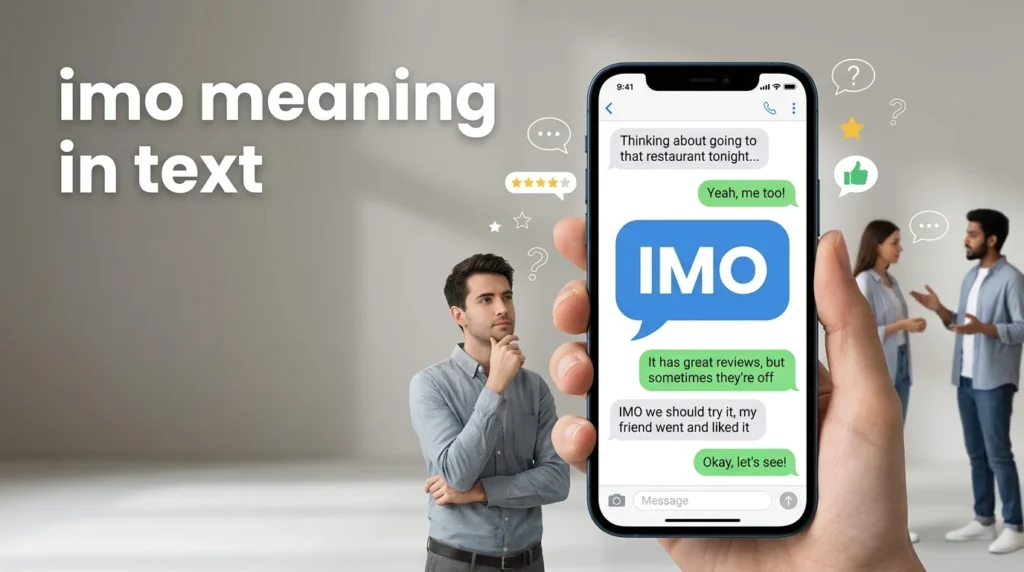
IMO in text usually means “In My Opinion.” People use it in casual messages and online conversations to show that the statement that follows expresses their personal view rather than an established fact.
IMO meaning in text refers to the abbreviation “In My Opinion.” It is one of the most common expressions used to introduce a personal thought, judgment, or preference in digital conversations.
For example, someone might write, “IMO, this is the best movie in the series.” The writer is making it clear that the statement represents their own opinion. IMO can make a message sound less absolute because it tells the reader that the idea comes from the speaker’s personal point of view.
You will often see IMO in text messages, social media posts, comments, forums, and direct messages. It works best in casual or conversational writing, although the full phrase can appear in more formal contexts.
Key Facts About IMO
| Fact | Details |
|---|---|
| Meaning | In My Opinion |
| Type | Texting and internet abbreviation |
| Main Use | Introducing a personal opinion |
| Pronunciation | I-M-O |
| Style | Informal and conversational |
| Common Places | Text messages, social media, forums, DMs |
| Formal Use | Better to write the full phrase |
What Is IMO in Text?
IMO is an abbreviation for “In My Opinion.” A person uses it to signal that the following statement reflects their personal judgment or belief.
For example:
“IMO, the first book was better.”
The writer is not necessarily claiming that everyone agrees. Instead, they are presenting their own view.
IMO can appear at the beginning or, less often, in another position within a sentence. Its main purpose remains the same: it identifies a statement as an opinion.
IMO Meaning in Text
The standard meaning of IMO in texting is “In My Opinion.”
People use it when they want to share a personal view about a subject. That subject could be a movie, song, restaurant, sports team, product, book, idea, or everyday situation.
Consider these examples:
- “IMO, pizza is better than burgers.”
- “IMO, that was the best episode.”
- “This phone is overpriced, IMO.”
- “IMO, you made the right choice.”
In each example, IMO tells the reader that the statement comes from the writer’s personal perspective.
Why Do People Use IMO?
People use IMO to separate personal judgment from objective information.
Suppose someone writes:
“IMO, this restaurant has the best burgers.”
That sentence presents a preference. The writer is not claiming that the restaurant has officially been proven to have the best burgers.
This distinction can make online conversations more precise. It also helps soften strong statements, especially when people may have different opinions.
For that reason, IMO often appears during discussions, recommendations, debates, and conversations about personal preferences.
Examples of IMO in Text
Here are some natural examples of how IMO appears in everyday messages:
“IMO, this is the best option.”
Meaning: “In my opinion, this is the best option.”
“IMO, you should wait a few days.”
The writer is offering personal advice.
“That movie was too long, IMO.”
The writer is sharing a personal reaction.
“IMO, the blue one looks better.”
The writer is expressing a preference.
“This is the best album they have made, IMO.”
The writer is giving their personal judgment.
“IMO, both choices are good.”
The writer is sharing a personal assessment.
These examples show that IMO can introduce both strong opinions and simple preferences.
How to Reply to IMO
You do not need a special response when someone uses IMO. You can agree, disagree politely, or share your own view.
For example:
Friend: “IMO, the new version is better.”
Reply: “I agree. The design looks cleaner.”
Or:
Friend: “IMO, the old version was better.”
Reply: “I see your point, but I prefer the new one.”
You can even respond with your own opinion marker:
“IMO, they both have advantages.”
The abbreviation helps keep the exchange casual and conversational.
IMO vs Similar Text Abbreviations
IMO has several related abbreviations that people may use when expressing opinions or responding to other people’s views.
| Term | Meaning | How It Differs |
|---|---|---|
| IMO | In My Opinion | Introduces a personal opinion |
| IMHO | In My Humble Opinion | Similar to IMO, often with a softer or self-conscious tone |
| IME | In My Experience | Introduces something based on personal experience |
| IIRC | If I Recall Correctly | Signals uncertainty about a remembered fact |
| TBH | To Be Honest | Introduces a candid or frank statement |
| FYI | For Your Information | Provides information rather than an opinion |
These abbreviations can overlap in casual conversations, but their purposes are not identical.
Is IMO Formal or Informal?
IMO is generally informal. It fits naturally in text messages, online discussions, social media comments, and casual emails.
For formal writing, it is usually better to write “in my opinion” instead of using the abbreviation.
For example, a formal sentence might say:
“In my opinion, this approach offers the clearest solution.”
The full expression looks more polished and avoids assuming that every reader knows internet abbreviations.
Is IMO the Same as IMHO?
IMO and IMHO have almost the same basic function. Both introduce a personal opinion.
IMO means “In My Opinion.”
IMHO commonly means “In My Humble Opinion.”
The main difference is tone. IMHO can sound more modest, playful, or self-aware. In everyday texting, the distinction is often small, and people may use either abbreviation to introduce a personal view.
Common Mistakes With IMO
A common mistake is treating an IMO statement as an established fact. If someone writes, “IMO, this is the best phone,” they are expressing a preference rather than presenting an objective ranking.
Another mistake is using IMO repeatedly in the same conversation. Once the reader understands that you are sharing your opinion, repeating the abbreviation in every sentence can make the writing feel unnecessary.
Using IMO in highly formal documents can create another problem. The abbreviation may appear too casual for academic, legal, business, or official writing.
Can IMO Sound Rude?
IMO itself is not rude. The tone depends on the statement that follows it.
For example:
“IMO, this design needs some changes.”
This can sound constructive.
By contrast:
“IMO, your idea makes no sense.”
The abbreviation does not make the criticism polite. The wording still matters.
If you disagree with someone, respectful language usually works better than relying on IMO to soften a harsh statement.
Is IMO Used on Social Media?
Yes. IMO is common in social media comments, online discussions, forums, and direct messages.
People often use it when discussing movies, music, sports, products, current events, food, fashion, or other subjects that invite personal opinions.
A typical comment might say:
“IMO, the original version is still better.”
The abbreviation quickly tells readers that the writer is giving a personal assessment.
When Should You Use IMO?
Use IMO when you want to make it clear that you are sharing a personal opinion.
It works especially well when a statement could otherwise sound like an absolute claim. Adding IMO can clarify that you are speaking from your own perspective.
For example:
“IMO, this is the easiest way to learn it.”
That wording presents the idea as personal advice rather than a universal rule.
In formal writing, use “in my opinion” instead. The complete phrase is clearer and more appropriate for professional readers.
FAQs
What does IMO mean in text?
IMO usually means “In My Opinion.” It is used to introduce a personal view, judgment, preference, or belief in a casual conversation.
What does IMO mean in texting?
In texting, IMO stands for “In My Opinion.” People use it to show that the statement that follows represents their personal perspective.
What does IMO mean from a girl?
The meaning does not change based on who sends it. If a girl uses IMO in a text, she generally means “In My Opinion.”
What does IMO mean from a guy?
A guy using IMO is generally saying “In My Opinion.” The abbreviation simply marks the following statement as his personal view.
Is IMO a slang word?
IMO is better described as a texting or internet abbreviation rather than a traditional slang word. It is widely understood in casual digital communication.
What is the difference between IMO and IMHO?
IMO means “In My Opinion,” while IMHO usually means “In My Humble Opinion.” Both introduce a personal opinion, but IMHO can carry a more modest or playful tone.
Is IMO rude in a text?
No. IMO is not inherently rude. The tone depends on the words that follow it and the overall conversation.
Should I use IMO in formal writing?
It is usually better to write “in my opinion” in formal writing. The full phrase is more appropriate for academic, professional, and official communication.
Conclusion
IMO means “In My Opinion” and helps people identify a statement as their personal view. It is especially common in casual texts, social media, and online discussions.
For formal communication, writing the complete phrase is usually the clearer and more professional choice.