
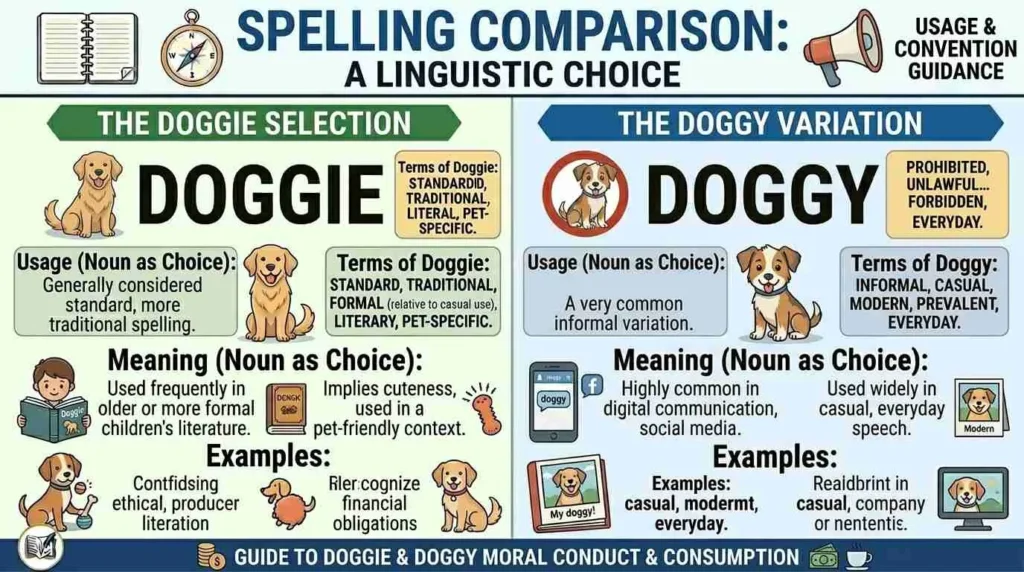

Many people wonder whether they should write doggy or doggie. The two words look very similar, sound exactly the same, and both refer to a dog in a friendly or affectionate way. Because of this, writers, pet owners, students, and English learners often become confused about which spelling is correct.
The good news is that both doggy and doggie are accepted spellings in English. Unlike many spelling comparisons where one version is wrong, both forms are recognized and commonly used. However, there are slight differences in style, popularity, and context.
You may see doggie more often in children’s books, educational materials, and dictionaries. On the other hand, doggy frequently appears in everyday conversations, pet care articles, advertising, and popular expressions. Understanding these differences helps writers choose the most appropriate spelling for their audience.
This guide explains doggy or doggie in simple language. You will learn meanings, usage, history, examples, regional preferences, common mistakes, real world applications, grammar tips, and much more.
Quick Overview
Doggy and doggie are both correct spellings.
Both words refer to a dog in a friendly or affectionate manner.
Doggie is slightly more common in dictionaries.
Doggy is common in everyday speech and popular phrases.
Both forms are acceptable in informal writing.
Key Difference Between Doggy or Doggie
Although both spellings are correct, they are used slightly differently.
Doggie often appears in:
- Children’s books
- Educational content
- Dictionaries
- Beginner English materials
Doggy often appears in:
- Everyday conversations
- Pet related websites
- Marketing content
- Popular expressions
The meaning remains the same in most situations.
Comparison Table
| Feature | Doggy | Doggie |
|---|---|---|
| Correct Spelling | Yes | Yes |
| Dictionary Recognition | Yes | Yes |
| Informal Usage | Very Common | Very Common |
| Children’s Writing | Common | More Common |
| Pet Industry Usage | Common | Common |
| Meaning | Friendly word for dog | Friendly word for dog |
| Pronunciation | Same | Same |
What Does Doggy Mean
Doggy is an informal and affectionate word for a dog.
People often use it when talking to children or when expressing affection toward pets.
Examples include:
- Look at that cute doggy.
- My doggy loves playing in the park.
- The little doggy is sleeping.
The word creates a friendly and warm tone.
What Does Doggie Mean
Doggie has the same meaning as doggy.
It is simply an alternative spelling that many dictionaries list as the preferred variation.
Examples include:
- The doggie wants a treat.
- That doggie looks happy.
- The doggie followed its owner home.
Most readers understand both spellings immediately.
History of Doggy and Doggie
The words developed as affectionate forms of the word dog.
English speakers often create friendly versions of words by adding sounds that feel softer and more playful.
Examples include:
- Kitty from cat
- Birdie from bird
- Doggie from dog
Over time, doggy became another accepted variation.
As language evolved, both spellings became common in everyday English.
Why People Get Confused Between Doggy or Doggie
Several factors contribute to confusion.
Identical Pronunciation
Both words sound exactly alike.
Therefore, many people assume only one can be correct.
Different Dictionary Preferences
Some dictionaries place doggie first.
Others list both spellings equally.
Regional Writing Habits
Certain regions favor one spelling more often than the other.
Personal Preference
Many writers simply choose the version they grew up seeing.
Doggy vs Doggie in Everyday Conversation
In spoken English, there is no difference because both words sound the same.
Examples:
- What a cute doggy.
- What a cute doggie.
Both sentences sound identical when spoken.
As a result, the choice usually depends on writing style rather than pronunciation.
Visual Comparison of Doggy or Doggie
Both spellings are accepted and widely understood. The choice often depends on style and audience.
Doggy and Doggie in Children’s Literature
Children’s books frequently use both forms.
However, doggie appears slightly more often because it follows a pattern similar to:
- Kitty
- Birdie
- Horsie
Examples:
- The little doggie found a ball.
- The happy doggie ran home.
Writers choose doggie because it looks playful and child friendly.
Doggy and Doggie in Pet Industry Marketing
Pet businesses commonly use both spellings.
Examples include:
- Doggy daycare
- Doggy grooming
- Doggy treats
- Doggie daycare
- Doggie bakery
- Doggie spa
Marketing teams often select the version that sounds best with their brand name.
Doggy in Popular Expressions
Certain expressions strongly favor doggy.
Examples include:
- Doggy bag
- Doggy paddle
- Doggy door
These phrases are widely accepted and rarely changed to doggie.
For this reason, many people become more familiar with the doggy spelling.
Doggie in Informal Writing
Doggie appears frequently in:
- Children’s stories
- Greeting cards
- Pet blogs
- Family content
Examples:
- Our doggie loves the beach.
- The doggie received a birthday gift.
The word creates a friendly and affectionate feeling.
Second Visual Learning Section


4
Many industries and writers use both spellings successfully depending on their audience.
Advantages and Disadvantages of Using Doggy
Advantages
- Familiar to many readers
- Common in popular expressions
- Frequently used in pet businesses
- Easy to recognize
Disadvantages
- Some style guides prefer doggie
- Less common in certain children’s materials
Advantages and Disadvantages of Using Doggie
Advantages
- Often preferred in dictionaries
- Common in children’s literature
- Friendly appearance
- Educational materials frequently use it
Disadvantages
- Less common in certain established phrases
- Some businesses prefer doggy branding
Real World Examples
Example One
A pet care company launches a service called Happy Doggy Daycare.
Example Two
A children’s book includes a character named Lucky Doggie.
Example Three
A family writes a greeting card saying:
“Our doggie misses you.”
Example Four
A pet owner posts online:
“My doggy learned a new trick today.”
All examples are considered acceptable.
Common Mistakes When Using Doggy or Doggie
Mistake One
Thinking one spelling is wrong.
Correction:
Both spellings are correct.
Mistake Two
Using different spellings repeatedly in the same article.
Correction:
Choose one spelling and remain consistent.
Mistake Three
Assuming dictionaries only recognize doggie.
Correction:
Most major dictionaries recognize both.
Mistake Four
Changing established expressions.
Correction:
Keep phrases such as doggy bag and doggy paddle unchanged.
Related Words and Similar Terms
Several words follow a similar pattern.
Kitty
Affectionate form of cat.
Birdie
Friendly form of bird.
Bunny
Friendly form of rabbit.
Puppy
Young dog.
Doggy
Friendly form of dog.
Doggie
Alternative friendly form of dog.
Doggy vs Dog
The word dog is neutral.
The words doggy and doggie are affectionate.
Example:
Dog:
The dog is in the yard.
Doggy:
The doggy is playing in the yard.
The second sentence sounds warmer and friendlier.
Doggy vs Puppy
These words are not identical.
Puppy
Refers specifically to a young dog.
Doggy
Can refer to a dog of any age.
Example:
A puppy grows into an adult dog.
The adult dog can still be called a doggy affectionately.
Regional Usage Around the World
English speakers around the world use both spellings.
United States
Both doggy and doggie are common.
United Kingdom
Both forms appear regularly.
Canada
Writers use both spellings.
Australia
Doggy and doggie are both accepted.
No major English speaking country considers either spelling incorrect.
Third Visual Comparison Section
The choice between doggy and doggie often depends on style, audience, and personal preference rather than correctness.
Beginner to Advanced Understanding
Beginner Level
Doggy and doggie are both correct.
Both mean dog.
Intermediate Level
Doggie appears slightly more often in children’s content.
Doggy appears frequently in common expressions.
Advanced Level
Professional writers choose based on audience expectations, branding, style guides, and consistency requirements.
Exercises With Answers
Question One
Which spelling is correct?
Answer: Both doggy and doggie.
Question Two
Do the two words have different meanings?
Answer: No.
Question Three
Which spelling appears more often in children’s books?
Answer: Doggie.
Question Four
Which spelling appears in doggy bag?
Answer: Doggy.
Question Five
Do both spellings appear in dictionaries?
Answer: Yes.
Question Six
Are both acceptable in informal writing?
Answer: Yes.
Question Seven
Do they have different pronunciations?
Answer: No.
Question Eight
Should writers stay consistent?
Answer: Yes.
Question Nine
Can businesses use either spelling?
Answer: Yes.
Question Ten
Do both words refer to a dog?
Answer: Yes.
Related Comparisons
Dog vs Puppy
Doggy vs Puppy
Kitty vs Cat
Birdie vs Bird
Pet Names vs Formal Animal Names
Informal English vs Formal English
Affectionate Terms in English
Common Spelling Variations in English
FAQs
Is doggy or doggie correct?
Both doggy and doggie are correct spellings.
Which spelling is more common?
Doggie appears slightly more often in dictionaries and children’s materials.
Do doggy and doggie mean the same thing?
Yes, both refer to a dog in a friendly way.
Is doggy wrong?
No, doggy is a correct English spelling.
Is doggie more formal than doggy?
Neither is considered formal. Both are informal and affectionate.
Why do dictionaries often show doggie first?
Some dictionaries treat doggie as the primary spelling, but they still recognize doggy.
Can I use doggy in professional pet content?
Yes, many pet businesses use doggy successfully.
What is a doggy bag?
A doggy bag is a container used to take leftover food home from a restaurant.
Should I use both spellings in the same article?
It is better to choose one spelling and stay consistent.
Which spelling is better for children?
Many children’s books prefer doggie, although both work well.
Conclusion
Understanding doggy or doggie is easier than many spelling comparisons because both forms are correct. They share the same meaning, pronunciation, and purpose. Both words refer to a dog in a friendly, affectionate, and informal way.
Doggie is slightly more common in dictionaries, educational materials, and children’s books. Meanwhile, doggy appears frequently in everyday conversations, pet related businesses, and popular expressions such as doggy bag and doggy paddle.
The most important rule is consistency. If you choose doggy, use it throughout your content. If you choose doggie, remain consistent with that spelling. Doing so improves readability and professionalism.
Whether you write doggy or doggie, readers will understand your meaning clearly. Both spellings are accepted across major English speaking countries and continue to be popular in modern communication.