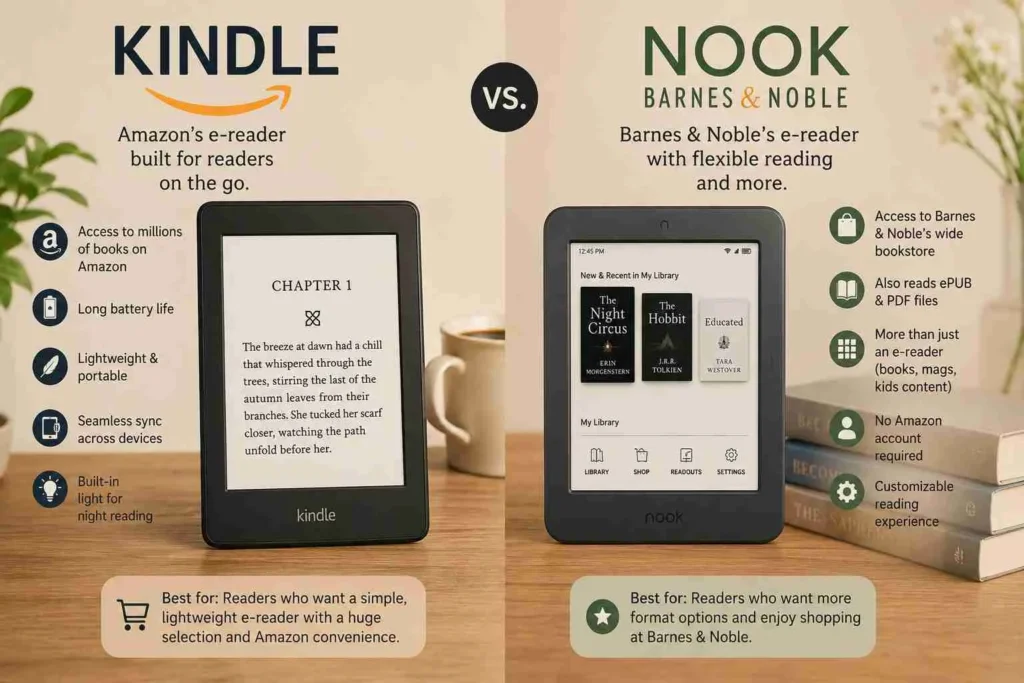

Many readers compare Kindle or Nook when shopping for an eReader. Both devices allow users to carry thousands of books in one lightweight device. They offer long battery life, glare free screens, and convenient access to digital libraries.
However, choosing between Kindle and Nook is not always easy. Both devices appear similar at first glance, yet they differ in ecosystem, ebook selection, hardware features, pricing, software experience, and customer support.
Some readers prefer Kindle because of its huge ebook collection and integration with Amazon services. Others choose Nook because they enjoy shopping through Barnes and Noble or prefer its interface.
Understanding Kindle or Nook helps buyers avoid spending money on the wrong device. A student may need affordable textbooks. A casual reader may want easy access to bestsellers. An avid book lover may care most about storage and battery life.
This guide explains Kindle or Nook in simple language. You will learn about features, benefits, disadvantages, real world examples, common mistakes, comparisons, buying factors, and practical advice for every type of reader.
Quick Overview
Kindle is an eReader developed by Amazon.
Nook is an eReader developed by Barnes and Noble.
Kindle offers a larger ebook ecosystem.
Nook focuses on the Barnes and Noble bookstore experience.
Both devices are designed for comfortable reading.
Key Difference Between Kindle or Nook


5
The biggest difference between Kindle and Nook is the content ecosystem.
Kindle connects users to Amazon’s ebook marketplace and services.
Nook connects users primarily to the Barnes and Noble digital bookstore.
For many buyers, this ecosystem difference is the most important factor.
What Is Kindle
Kindle is a dedicated eReader designed for reading ebooks, magazines, and digital content.
It uses E Ink technology that closely resembles paper. This reduces eye strain and improves outdoor readability.
Kindle models often include:
- Adjustable front lighting
- Long battery life
- Cloud storage
- Built in bookstore access
- Reading progress tracking
Kindle has become one of the most recognized eReader brands in the world.
What Is Nook
Nook is an eReader developed by Barnes and Noble.
Like Kindle, it uses E Ink display technology to create a paper like reading experience.
Nook devices focus on:
- Digital books
- Magazines
- Comfortable reading
- Library integration
- Barnes and Noble content access
Nook remains popular among readers who already use Barnes and Noble services.
Kindle vs Nook Comparison Table
| Feature | Kindle | Nook |
|---|---|---|
| Developer | Amazon | Barnes and Noble |
| Ebook Store | Amazon Store | Barnes and Noble Store |
| Battery Life | Excellent | Very Good |
| Ebook Selection | Extensive | Large |
| Cloud Integration | Strong | Moderate |
| Global Availability | Wide | More Limited |
| Subscription Options | Multiple | Fewer |
| Device Variety | Extensive | Limited |
Design and Build Quality
Both Kindle and Nook are designed for portability.
Kindle Design
Kindle devices usually feature:
- Lightweight construction
- Slim profile
- Durable materials
- Waterproof options on some models
Many users appreciate the premium feel of higher end Kindle models.
Nook Design
Nook devices focus on simplicity and comfort.
Features often include:
- Comfortable grip
- Lightweight frame
- Easy navigation
- Clean reading interface
For basic reading, both devices perform very well.
Display Quality Comparison


6
The display is one of the most important parts of any eReader.
Kindle Display
Kindle screens provide:
- High contrast text
- Adjustable brightness
- Sharp fonts
- Excellent outdoor visibility
Nook Display
Nook screens offer:
- Crisp text rendering
- Comfortable reading experience
- Adjustable lighting
- Good readability in sunlight
Most readers find both displays excellent for long reading sessions.
Ebook Library and Content Availability
Content availability often determines which device is better for a specific reader.
Kindle Library
Kindle users gain access to:
- Millions of ebooks
- Bestselling titles
- Independent publications
- Self published books
- Digital magazines
Nook Library
Nook users access:
- Barnes and Noble ebook catalog
- Digital magazines
- Newspapers
- Popular fiction and nonfiction
Kindle generally provides a larger content ecosystem.
Reading Experience
Reading comfort is essential.
Kindle Reading Experience
Kindle includes:
- Dictionary tools
- Highlighting
- Notes
- Vocabulary builder
- Reading statistics
Nook Reading Experience
Nook includes:
- Bookmarks
- Notes
- Adjustable fonts
- Reading customization
Both devices support distraction free reading.
Battery Life Comparison
Battery life is a major advantage of eReaders.
Kindle Battery Life
Many Kindle devices can last weeks on a single charge.
Nook Battery Life
Nook devices also provide excellent battery life and often last for weeks.
Heavy users may need more frequent charging, but both outperform tablets significantly.
Storage Capacity
Modern readers often carry thousands of books.
Kindle Storage
Storage options vary by model.
Many users can store thousands of ebooks without running out of space.
Nook Storage
Nook devices also provide ample storage for typical readers.
For most people, storage will not be a deciding factor.
Ecosystem and Services


5
The ecosystem can dramatically affect long term satisfaction.
Kindle Ecosystem
Benefits include:
- Cloud synchronization
- Multi device reading
- Book recommendations
- Audiobook integration
- Subscription services
Nook Ecosystem
Benefits include:
- Barnes and Noble integration
- Simple bookstore access
- Familiar reading environment
Kindle generally offers a larger ecosystem.
Advantages of Kindle
Large Ebook Collection
Readers can access an enormous selection of titles.
Strong Ecosystem
Cloud features improve convenience.
Global Availability
Kindle devices are available in many regions.
Frequent Updates
Software improvements arrive regularly.
Disadvantages of Kindle
Store Dependence
Users become closely connected to the Amazon ecosystem.
Premium Models Cost More
Advanced models can be expensive.
Advantages of Nook
Simple Reading Experience
Nook focuses heavily on reading comfort.
Barnes and Noble Integration
Existing customers may prefer staying within the same ecosystem.
User Friendly Interface
Navigation is straightforward.
Disadvantages of Nook
Smaller Ecosystem
Content and services may be more limited.
Fewer Device Choices
There are fewer model options available.
Real World Examples
Example One Student Reader
A student wants affordable textbooks and study materials.
Kindle may offer broader availability.
Example Two Casual Reader
A casual reader mainly purchases books from Barnes and Noble.
Nook may feel more familiar.
Example Three Frequent Traveler
A traveler wants long battery life and cloud synchronization.
Kindle may provide additional convenience.
Kindle or Nook for Students
Students often need:
- Affordable books
- Highlighting tools
- Notes
- Long battery life
Both devices work well, but Kindle generally offers broader textbook access.
Kindle or Nook for Casual Readers
Casual readers usually care about:
- Ease of use
- Affordable pricing
- Comfortable reading
Both devices satisfy these needs.
Kindle or Nook for Avid Readers
Heavy readers often prioritize:
- Library size
- Recommendations
- Storage
- Reading tools
Kindle frequently has an advantage because of its larger ecosystem.
Common Mistakes When Choosing Kindle or Nook
Mistake One
Choosing based only on price.
Correction:
Consider the ebook ecosystem as well.
Mistake Two
Ignoring book availability.
Correction:
Check whether your preferred books exist in the platform store.
Mistake Three
Focusing only on hardware.
Correction:
Software and content matter just as much.
Mistake Four
Assuming all eReaders are identical.
Correction:
Features vary significantly between ecosystems.
Related Comparisons
Kindle vs Tablet
A tablet performs many tasks.
A Kindle focuses on reading.
Nook vs Tablet
Nook provides fewer distractions than a traditional tablet.
Physical Books vs eReaders
Physical books provide a traditional experience.
eReaders provide portability and convenience.
Regional and Global Usage
Kindle has broader international reach.
Nook remains strongest among Barnes and Noble customers.
In some countries, Kindle availability and content selection may be significantly larger.
Beginner to Advanced Understanding
Beginner Level
Kindle and Nook are digital reading devices.
Intermediate Level
Both offer E Ink displays and digital bookstores.
Advanced Level
The ecosystem, content licensing, cloud services, and reading tools often determine which platform is better.
Exercises With Answers
Question One
Which company makes Kindle?
Answer: Amazon.
Question Two
Which company makes Nook?
Answer: Barnes and Noble.
Question Three
What is the main purpose of both devices?
Answer: Reading digital books.
Question Four
Which device generally offers a larger ebook ecosystem?
Answer: Kindle.
Question Five
Do both devices use E Ink technology?
Answer: Yes.
Question Six
Can both store thousands of books?
Answer: Yes.
Question Seven
Which platform has stronger global availability?
Answer: Kindle.
Question Eight
Are both suitable for long reading sessions?
Answer: Yes.
FAQs
Is Kindle better than Nook?
It depends on your reading habits. Kindle generally offers a larger ecosystem and content library.
Can Nook read Kindle books?
Direct compatibility is limited because each platform uses its own ecosystem.
Which is cheaper Kindle or Nook?
Pricing varies by model and promotions.
Is Kindle good for students?
Yes, many students use Kindle for digital reading and studying.
Does Nook have a good ebook library?
Yes, Nook offers a large collection through Barnes and Noble.
Which device has better battery life?
Both provide excellent battery life measured in weeks.
Can I read outdoors with Kindle or Nook?
Yes, both use E Ink displays that perform well in sunlight.
Which is better for heavy readers?
Many avid readers prefer Kindle because of its larger ecosystem.
Do Kindle and Nook require internet all the time?
No. Books can be downloaded and read offline.
Is buying an eReader worth it?
Yes, especially for people who read frequently.
Conclusion
The Kindle or Nook debate ultimately comes down to ecosystem preference, reading habits, and content availability. Both devices offer comfortable reading experiences, long battery life, lightweight designs, and access to extensive digital libraries.
Kindle stands out because of its larger ebook ecosystem, stronger cloud integration, wider global availability, and extensive reading features. Nook remains a strong option for readers who prefer the Barnes and Noble environment and want a simple, focused reading experience.
Before making a purchase, consider where you buy books, how often you read, and which features matter most to you. Readers who want the largest content ecosystem often choose Kindle. Readers already invested in Barnes and Noble content may prefer Nook.
Both devices can transform the reading experience by making thousands of books available in a single portable device.