

Many English learners and writers wonder whether they should use boney or bony. Since both spellings appear online, the confusion is understandable. However, one spelling is much more common and widely accepted than the other.
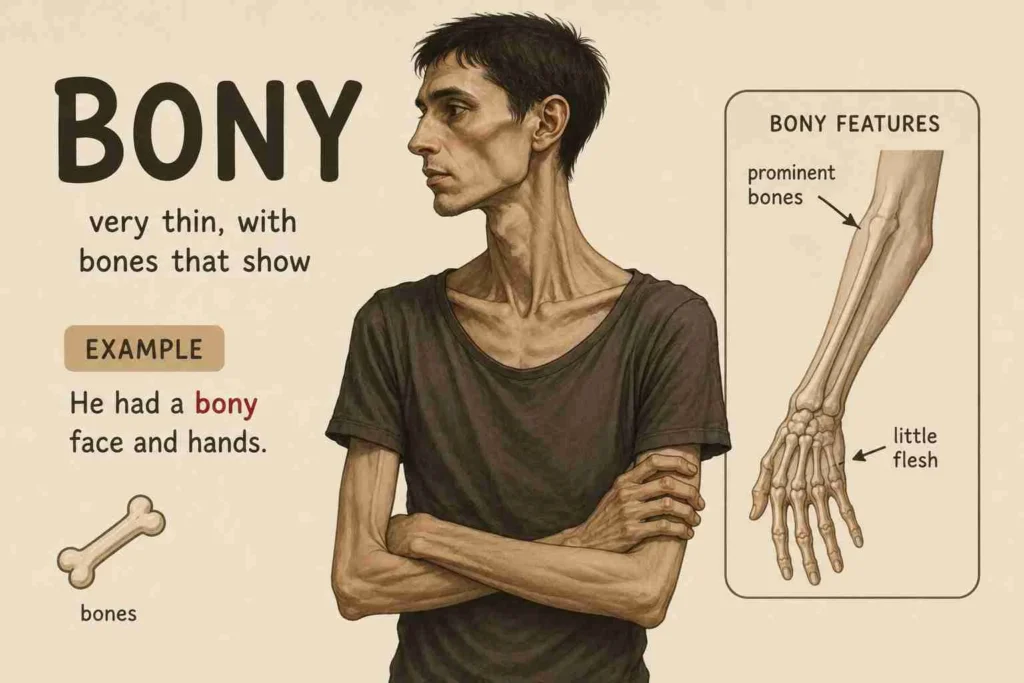
The word is often used to describe a thin person whose bones are easy to see. It can also describe animals, body parts, or objects that contain many bones. While both spellings may look similar, they are not equally preferred in modern English.
Understanding the difference between boney or bony can improve writing accuracy, grammar skills, and professional communication. This topic is especially useful for students, bloggers, content writers, teachers, and anyone who wants to write correct English.
In this guide, you will learn the meaning, spelling differences, usage examples, grammar rules, history, regional preferences, common mistakes, and practical exercises. By the end, you will know exactly when to use bony and why it is generally the better choice.
Quick Overview
Bony is the standard and preferred spelling.
Boney is an alternative spelling used less often.
Bony appears in dictionaries and formal writing.
Most professional writers use bony.
Both words generally carry the same meaning.
Definition of Bony
The word bony is an adjective.
It describes something that has many bones or appears thin because the bones are noticeable.
Examples include:
- A bony hand
- A bony shoulder
- A bony dog
- A bony fish
The word can describe people, animals, and physical structures.
Example Sentences
The child had a bony elbow.
The rescued dog looked thin and bony.
The bird had long bony legs.
Definition of Boney
Boney is an alternative spelling of bony.
Although some dictionaries recognize it, it is far less common in modern English.
Many style guides and editors recommend using bony because it is shorter, simpler, and more widely accepted.
Example Sentence
The old spelling boney may still appear in some books and informal writing.
However, modern publications usually prefer bony.
Key Difference Between Boney or Bony
The meaning is essentially the same.
The difference is mainly spelling preference and frequency of use.
Comparison Table
| Feature | Bony | Boney |
|---|---|---|
| Modern Standard English | Yes | Less Common |
| Dictionary Recognition | Yes | Sometimes |
| Professional Writing | Preferred | Rare |
| Academic Writing | Preferred | Rare |
| Everyday Usage | Very Common | Uncommon |
| Recommended Choice | Yes | Usually No |
Visual Comparison of Boney or Bony
The comparison highlights that bony is the spelling most writers, editors, and teachers recommend.
Origin and History of the Word
The word comes from bone, which refers to the hard structures that support the body.
Over time, English developed adjectives from nouns by adding endings.
Historically, both bony and boney appeared in written English.
However, language gradually favored bony because it follows a simpler spelling pattern.
Today, most dictionaries and style guides list bony as the preferred form.
Why People Confuse Boney or Bony
Several factors contribute to confusion.
Similar Pronunciation
Both spellings sound almost identical.
Therefore, many people assume both are equally correct.
Older Books and Publications
Some older texts use boney.
As a result, readers occasionally encounter both forms.
Internet Content
Many websites contain spelling inconsistencies.
This creates uncertainty for learners.
Informal Writing
Social media and casual writing often ignore standard spelling conventions.
Consequently, alternative forms continue to appear.
How Bony Is Used in Everyday English
The word appears frequently in daily conversations.
People often use it to describe physical appearance.
Examples include:
- A bony wrist
- A bony face
- A bony knee
- A bony shoulder
The word usually emphasizes that bones are clearly visible.
Bony in Medical and Health Contexts
Doctors and health professionals sometimes use the term.
It may describe body structures or physical characteristics.
Examples include:
- Bony prominence
- Bony growth
- Bony structure
- Bony anatomy
In medical writing, bony is overwhelmingly preferred over boney.
Bony in Animal Descriptions
Veterinarians and animal experts frequently use the word.
Examples include:
- A bony horse after illness
- A bony stray dog
- A bony fish species
The word helps describe visible skeletal features.
Bony in Anatomy and Biology


5
In biology and anatomy, bony refers to structures containing bone tissue.
Examples include:
- Bony skeleton
- Bony plates
- Bony framework
- Bony projections
Scientists regularly use the term in research and educational materials.
Bony in Literature and Creative Writing
Writers use bony to create vivid descriptions.
For example:
The old man rested his bony hands on the table.
The traveler had a bony face shaped by years of hardship.
Because the word creates strong visual imagery, it is common in novels and stories.
Grammar Rules for Bony
Bony functions as an adjective.
It modifies nouns.
Examples:
Correct: The dog looked bony.
Correct: She had bony fingers.
Correct: The bird had bony wings.
Incorrect: She was very bonying.
The word should remain in adjective form.
Advantages of Using Bony
Greater Acceptance
Most dictionaries favor bony.
Professional Appearance
Editors prefer the standard spelling.
Better Readability
Readers recognize it immediately.
Academic Accuracy
Schools and universities generally recommend bony.
Disadvantages of Using Boney
Less Common
Many readers view it as outdated.
Reduced Professionalism
Some editors may change it automatically.
Possible Confusion
Readers may wonder whether it is a spelling mistake.
Inconsistent Style
Using both spellings in the same document can appear unprofessional.
Real World Examples
Example One
A veterinarian described the rescued dog as extremely bony due to malnutrition.
Example Two
A doctor noted a bony swelling near the patient’s shoulder.
Example Three
A novelist described a character with a long bony face.
Example Four
An anatomy textbook explained the body’s bony framework.
Common Expressions Using Bony
English contains many common phrases featuring the word.
Examples include:
- Bony fingers
- Bony knees
- Bony shoulders
- Bony frame
- Bony structure
- Bony fish
These expressions appear frequently in books and articles.
Common Mistakes When Using Boney or Bony
Mistake One
Assuming both spellings are equally preferred.
Correction:
Use bony in professional writing.
Mistake Two
Using different spellings in one article.
Correction:
Choose one spelling and remain consistent.
Mistake Three
Believing boney is the modern standard.
Correction:
Bony is generally the accepted standard.
Mistake Four
Using the word negatively in every context.
Correction:
The word can be descriptive rather than critical.
Related Words and Similar Terms
Several words share similar meanings.
Thin
Describes a person with little body fat.
Lean
Refers to a slim and healthy build.
Skinny
Describes someone very thin.
Gaunt
Suggests thinness caused by illness or hardship.
Skeletal
Refers to an appearance where bones are highly visible.
Each word has a slightly different meaning and tone.
Bony Versus Skinny
Many people confuse these terms.
Bony
Focuses on visible bones.
Skinny
Focuses on overall thinness.
Someone can be skinny without appearing bony.
Likewise, someone can appear bony because certain bones are prominent.
Bony Versus Lean
Lean often carries a positive meaning.
Athletes are frequently described as lean.
Bony may sometimes suggest a lack of body fat or muscle.
Therefore, the words are not always interchangeable.
Bony Versus Gaunt


Gaunt often implies illness, exhaustion, or suffering.
Bony simply describes visible bones.
This distinction is important in professional writing.
Regional and Global Usage
American English
American English strongly favors bony.
British English
British English also prefers bony.
Canadian English
Bony is the dominant spelling.
Australian English
Most publications use bony.
Across major English speaking countries, bony remains the preferred choice.
Beginner to Advanced Understanding
Beginner Level
Bony is usually correct.
Boney is less common.
Intermediate Level
Both spellings exist, but professional writers prefer bony.
Advanced Level
Modern style guides, publishing standards, and dictionaries overwhelmingly favor bony due to consistency and frequency of use.
Practical Writing Tips
When writing professionally:
- Use bony consistently.
- Check spelling with a dictionary.
- Avoid switching between forms.
- Follow style guide recommendations.
- Use the word only when it accurately describes appearance.
These habits improve writing quality.
Exercises With Answers
Question One
Which spelling is preferred in modern English?
Answer: Bony
Question Two
Can bony describe animals?
Answer: Yes
Question Three
Is boney more common than bony?
Answer: No
Question Four
What part of speech is bony?
Answer: Adjective
Question Five
Which spelling appears more often in professional writing?
Answer: Bony
Question Six
Can doctors use the word bony?
Answer: Yes
Question Seven
Does bony always have a negative meaning?
Answer: No
Question Eight
Which spelling should students use?
Answer: Bony
Question Nine
Can bony describe anatomy?
Answer: Yes
Question Ten
Which spelling is recommended by most editors?
Answer: Bony
Frequently Asked Questions
Is bony or boney correct?
Both exist, but bony is the preferred modern spelling.
Why is bony more common than boney?
Most dictionaries and style guides recommend bony.
Is boney wrong?
Not completely, but it is less common and often avoided in professional writing.
Should students use bony or boney?
Students should generally use bony.
Do dictionaries recognize boney?
Some dictionaries mention it as an alternative spelling.
Is bony used in medical writing?
Yes, it is very common in medical and anatomical descriptions.
Can animals be described as bony?
Yes, especially if their bones are visible.
Is bony the same as skinny?
Not exactly. Bony focuses on visible bones, while skinny refers to overall thinness.
Which spelling should bloggers use?
Bloggers should normally use bony.
Is bony accepted worldwide?
Yes, it is the preferred spelling in major English speaking countries.
Conclusion
Understanding boney or bony is important for accurate and professional English writing. Although both spellings have appeared throughout history, modern English strongly favors bony. It is the spelling found most often in dictionaries, academic materials, professional publications, medical writing, and everyday communication.
The word describes something that has visible bones or contains bone structures. It can refer to people, animals, anatomy, and physical objects. While boney occasionally appears in informal or older writing, most editors and language experts recommend using bony for consistency and clarity.
Whether you are writing a school assignment, blog post, business document, medical article, or creative story, choosing bony helps ensure your writing matches modern English standards. When deciding between boney or bony, remember the simple rule: bony is the preferred spelling, while boney is the less common alternative.