
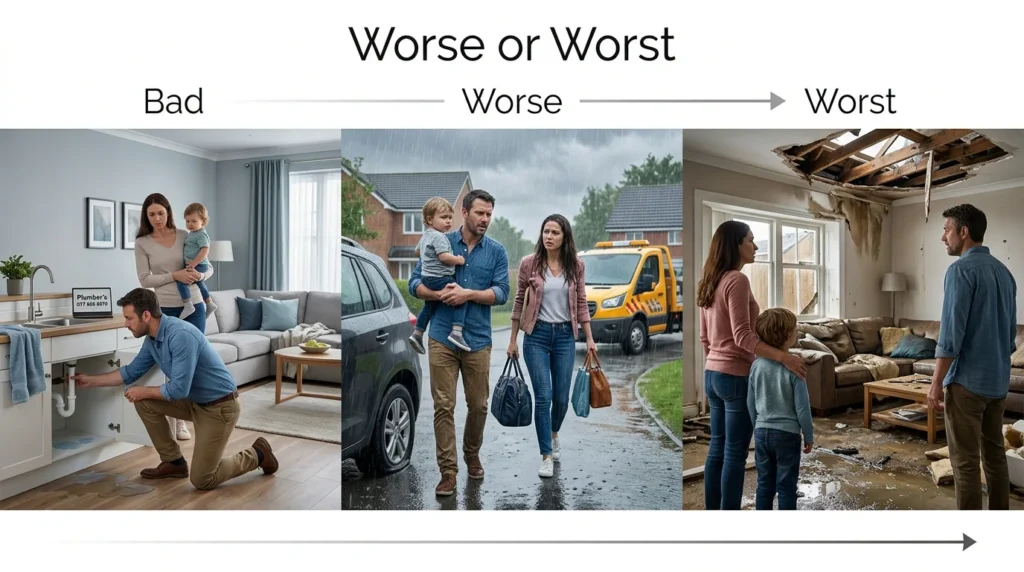

Quick Answer
Worse is the comparative form of bad, while worst is the superlative form. Use worse when comparing two things or situations, and use worst when talking about the lowest or most negative level among three or more things.
Worse and worst are easy to confuse because both words describe something negative. They are also related to the word bad, which makes the difference seem less obvious at first.
The simple rule is this: worse compares one thing with another, while worst describes the most negative option in a group or situation. For example, you can say, “Today is worse than yesterday.” If you are talking about the lowest point of several difficult days, you might say, “Monday was the worst day of the week.”
Once you understand the comparison behind each word, choosing between worse or worst becomes much easier.
What Does Worse Mean?
Worse means less good, less pleasant, more serious, or more negative than something else.
It is the comparative form of bad.
The basic pattern is:
bad → worse → worst
For example:
This movie is worse than the first one.
The sentence compares two movies.
You can also use worse when talking about a situation that has become less favorable.
For example:
- My headache is getting worse.
- The weather became worse during the afternoon.
- His condition looks worse today.
- The traffic is worse than usual.
- Things could get worse.
In each case, worse describes a decline or comparison.
What Does Worst Mean?
Worst means the least good, most unpleasant, most serious, or most negative.
It is the superlative form of bad.
The pattern is:
bad → worse → worst
For example:
That was the worst meal I have ever had.
Here, the speaker is describing the lowest point among many meals.
Other examples include:
- This is the worst day of my week.
- That was the worst mistake I made.
- She had the worst experience.
- This is the worst traffic I have seen all year.
- He prepared for the worst.
The word worst often describes the extreme end of a situation.
Worse vs Worst: The Main Difference
The easiest way to understand the difference is to think about comparison.
Worse usually compares two things.
Worst usually identifies one thing as the most negative among a group.
| Word | Use | Example |
|---|---|---|
| Worse | Comparative | Today is worse than yesterday. |
| Worst | Superlative | Today was the worst day this week. |
Think of it this way:
Worse = more bad
Worst = most bad
We normally do not say “more bad” or “most bad” in standard English. Instead, we use worse and worst.
Bad, Worse, and Worst
These three words form a useful comparison.
Bad
Use bad when describing something negative without making a comparison.
The weather is bad.
Worse
Use worse when comparing something with another thing or an earlier condition.
The weather is worse today than yesterday.
Worst
Use worst when describing the most negative condition in a group or situation.
Today has the worst weather of the week.
This three-step pattern is one of the easiest ways to remember the difference.
When Should You Use Worse?
Use worse when one thing is less good or more negative than another.
For example:
This problem is worse than the previous one.
You can also use worse when something changes in a negative direction.
For example:
My cold is getting worse.
Notice that the second sentence does not directly compare two things. The comparison is understood over time. The condition was better before and has now declined.
Other examples include:
- The traffic is getting worse.
- His mood became worse after the argument.
- The situation is worse than we expected.
- This option looks worse than the other one.
- The pain became worse overnight.
When Should You Use Worst?
Use worst when something represents the lowest or most negative point.
For example:
That was the worst decision of my life.
The speaker is not simply comparing two decisions. The decision is being described as the most negative among many decisions.
More examples:
- This is the worst restaurant in the area.
- Monday was the worst day of the week.
- That was the worst part of the trip.
- He made the worst choice.
- It was the worst storm of the year.
The word often appears with phrases such as the worst, my worst, your worst, or their worst.
Worse Than
One of the most common structures with worse is:
worse than
This is used to compare two things.
Examples:
- This movie is worse than the original.
- The traffic is worse than yesterday.
- My new phone is worse than my old one.
- The second option is worse than the first.
- His performance was worse than mine.
The word than often makes the comparison easy to recognize.
However, worse does not always need than.
For example:
My headache is getting worse.
There is no than in this sentence, but the comparison is still understood. The headache is becoming more severe than it was before.
The Worst
The worst is a very common phrase.
It identifies the most negative person, thing, experience, or situation in a particular group or context.
Examples:
- That was the worst part.
- This is the worst movie.
- She had the worst luck.
- He is the worst driver in the group.
- That was the worst decision.
The word the often appears before worst, especially when you are identifying one thing as the lowest or most negative example.
Worst Than Is Incorrect
One common mistake is writing:
This is worst than yesterday.
That is incorrect.
The correct sentence is:
This is worse than yesterday.
Why?
Because than usually introduces a comparison, and the comparative form is worse.
Remember:
worse than
Not:
worst than
For example:
My new job is worse than my old job.
Worse or Worst With “Ever”
Both words can appear with ever, but they do different jobs.
For example:
This is the worst movie I have ever seen.
Here, worst means that the movie ranks at the bottom among all the movies the speaker has seen.
You can also say:
My health is worse than it has ever been.
Here, worse compares the current condition with previous conditions.
The difference becomes clear when you look at what is being compared.
Worse Than Before
The phrase worse than before is very common.
It means that something has declined compared with its earlier condition.
Examples:
- The traffic is worse than before.
- His attitude is worse than before.
- The problem is worse than before.
- The weather is worse than before.
- My back feels worse than before.
The focus is on a change from an earlier state.
Worse Than Expected
Another common expression is worse than expected.
It means that something turned out to be more negative than someone predicted.
Examples:
- The damage was worse than expected.
- The traffic was worse than expected.
- The results were worse than expected.
- The storm was worse than expected.
- The situation became worse than expected.
This phrase is useful in both everyday and professional communication.
Worst Case Scenario
One of the most common expressions with worst is worst-case scenario.
It refers to the most negative possible outcome being considered.
For example:
We should prepare for the worst-case scenario.
Another example:
In the worst-case scenario, the project could take another month.
This expression is common in business, planning, emergency preparation, and everyday conversations.
Prepare for the Worst
The phrase prepare for the worst means getting ready for the most negative possible outcome.
For example:
We hope the storm misses us, but we should prepare for the worst.
Another example:
The doctors are doing everything possible, but the family is preparing for the worst.
The phrase does not mean that the worst outcome will definitely happen. It simply means that someone is preparing for a serious possibility.
If Worse Comes to Worst
You may also hear the expression:
if worse comes to worst
It means that if a difficult situation becomes as bad as it possibly can, another plan may be used.
For example:
If worse comes to worst, we can stay with my brother.
Another example:
If worse comes to worst, we will cancel the trip.
The phrase is about dealing with a situation if it reaches its most difficult point.
For Better or Worse
Another common expression is:
for better or worse
It means regardless of whether the result is good or bad.
For example:
For better or worse, the decision has already been made.
You might also hear:
For better or worse, technology has changed how we communicate.
Here, worse does not compare two things directly. It is part of a fixed expression.
Worse in Everyday Conversation
People use worse frequently when talking about changes.
For example:
“How is your knee?”
“It feels worse today.”
Or:
“Is the traffic bad?”
“Yes, it is worse than yesterday.”
You can also use worse to describe situations that are becoming more difficult.
Things are getting worse.
The weather keeps getting worse.
The situation could get worse.
These are natural everyday uses.
Worst in Everyday Conversation
Worst is also common in casual speech.
For example:
“How was the restaurant?”
“It was the worst.”
Someone might also say:
“That was the worst!”
Depending on context, this can be serious or exaggerated.
Another common example is:
“What is the worst that could happen?”
This question is often used when someone wants to think about the most negative possible result.
Worse or Worst With Problems
Both words work well with problem, but they create different meanings.
For example:
This problem is worse than the last one.
You are comparing two problems.
Now consider:
This is the worst problem we have faced.
Here, the problem is being ranked as the most serious among several problems.
The same rule applies to many other nouns.
Worse or Worst With Experiences
Consider these examples:
My second trip was worse than my first trip.
This compares two experiences.
Now:
That was the worst trip of my life.
This identifies one experience as the most negative.
So when you are comparing two experiences, think worse.
When you are identifying the most negative experience, think worst.
Common Mistakes With Worse and Worst
Here are some mistakes that appear often.
Mistake One: Worst Than
Incorrect:
This movie is worst than the other one.
Correct:
This movie is worse than the other one.
Mistake Two: Worse of All
In many ranking situations, the natural form is:
the worst of all
For example:
That was the worst of all the options.
Mistake Three: Using Worst for Two Things
When comparing two things directly, worse is normally the right choice.
For example:
Which is worse, coffee or tea?
Not:
Which is worst, coffee or tea?
Mistake Four: Using Worse for the Lowest Ranking
If you are ranking several things and identifying the lowest one, use worst.
For example:
This was the worst option of the five.
Not:
This was the worse option of the five.
Worse or Worst When Comparing Two Things
This is an important rule.
When you compare two things, worse is normally used.
For example:
Which is worse, missing the bus or missing the train?
There are two choices.
Another example:
Which is worse, a headache or a toothache?
Again, the sentence compares two things.
This is why worse is the natural choice.
Worse or Worst When Comparing Three or More Things
When you identify the most negative option among three or more things, worst is normally used.
For example:
Of the three hotels, this one was the worst.
Or:
Friday was the worst day of the week.
There may be many possible comparisons, but the important point is that worst identifies the extreme end of the group.
Worse Can Describe Change Over Time
You do not always need two separate objects to use worse.
Time itself can create the comparison.
For example:
The weather is getting worse.
This means the weather is becoming less pleasant than it was earlier.
Other examples:
- The situation is getting worse.
- My cold is getting worse.
- The traffic is getting worse.
- The noise is getting worse.
- His mood is getting worse.
The earlier condition acts as the comparison point.
Worst Can Describe an Extreme Situation
Worst often points to an extreme.
For example:
We were prepared for the worst.
This means we were prepared for the most negative possible outcome.
Another example:
That was the worst moment of the entire experience.
The speaker is identifying the lowest point.
This is different from simply saying:
That moment was worse than the previous one.
The first sentence identifies the extreme. The second makes a comparison.
A Simple Memory Trick
Use this three-step pattern:
Bad → Worse → Worst
Think of it as a ladder.
Bad describes something negative.
Worse moves one level down when comparing.
Worst reaches the lowest point.
For example:
The weather is bad.
Then:
Today’s weather is worse than yesterday’s.
And finally:
Today has the worst weather of the week.
This pattern can help you choose the correct word quickly.
Practice Questions
Choose worse or worst.
1. This is the ______ movie I have ever seen.
Answer: worst
You are identifying the lowest ranking among all the movies you have seen.
2. My headache is getting ______.
Answer: worse
The condition is becoming more severe.
3. This option is ______ than the other one.
Answer: worse
The sentence compares two options.
4. That was the ______ day of my vacation.
Answer: worst
You are identifying one day as the most negative.
5. Which is ______, rain or snow?
Answer: worse
The sentence compares two things.
6. We should prepare for the ______.
Answer: worst
The phrase refers to the most negative possible outcome.
7. The traffic today is ______ than yesterday.
Answer: worse
Two conditions are being compared.
8. That was the ______ mistake in the entire project.
Answer: worst
The mistake is being identified as the most serious one.
Quick Comparison Examples
Here are some examples that show the difference clearly:
Worse:
This phone is worse than my old phone.
Worst:
This is the worst phone I have ever owned.
Worse:
My cold is getting worse.
Worst:
This is the worst cold I have had in years.
Worse:
The second option is worse than the first.
Worst:
The third option is the worst of all.
These examples follow the same basic rule every time.
Worse or Worst in Questions
Questions often make the difference easy to spot.
Use worse for a direct comparison:
Which is worse, staying home or going out?
Use worst when asking about the most negative possibility:
What is the worst thing that could happen?
Another example:
What was the worst part of the trip?
The first question compares options. The second asks for the most negative part.
Worse or Worst in Formal Writing
Both words are perfectly normal in formal writing.
Examples:
The second outcome was worse than the first.
This represents the worst possible outcome.
The economic impact was worse than originally predicted.
The report described the worst-case scenario.
There is no need to replace these words with more complicated vocabulary. They are clear and standard English.
Worse or Worst in Professional Communication
These words are also useful at work.
For example:
The results were worse than expected.
The delay could get worse.
We need to prepare for the worst-case scenario.
This was the worst outcome for the project.
The main goal is clarity. Choose worse for comparison and worst for the extreme or lowest point.
Final Tips
Remember these simple rules:
- Bad is the basic form.
- Worse is the comparative form.
- Worst is the superlative form.
- Use worse when comparing two things.
- Use worst when identifying the most negative option.
- Worse than is a common and correct structure.
- Do not use worst than for a normal comparison.
- The worst often identifies the lowest point.
- Getting worse describes a negative change.
- Prepare for the worst refers to the most negative possible outcome.
- The easiest pattern to remember is bad → worse → worst.
FAQs
What is the difference between worse and worst?
Worse is the comparative form of bad and is generally used when comparing two things or describing a decline. Worst is the superlative form and identifies the most negative or least favorable option in a group.
Is it worse than or worst than?
The correct phrase for a normal comparison is worse than. For example, “This situation is worse than yesterday.” Worst than is not the standard form for this type of comparison.
Which is correct, worse or worst for two things?
Use worse when directly comparing two things. For example, “Which is worse, coffee or tea?” When identifying the most negative option in a larger group, use worst.
Can you say getting worse?
Yes. Getting worse is a very common expression. It means that something is becoming less good, more difficult, or more serious than it was before.
What does prepare for the worst mean?
Prepare for the worst means getting ready for the most negative possible outcome. It does not mean that the worst outcome will definitely happen. It means someone is preparing in case it does.
Conclusion
The difference between worse and worst becomes simple when you remember their relationship with bad. The basic form is bad, the comparative form is worse, and the superlative form is worst.
Use worse when you compare one thing with another or describe something becoming more negative. Use worst when you identify the lowest, most serious, or most unpleasant option. For example, “This problem is worse than the last one” compares two problems, while “This is the worst problem we have faced” identifies the most serious problem.
When you are unsure, ask yourself whether you are making a comparison or identifying the extreme. If you are comparing, choose worse. If you are describing the lowest point, choose worst.