
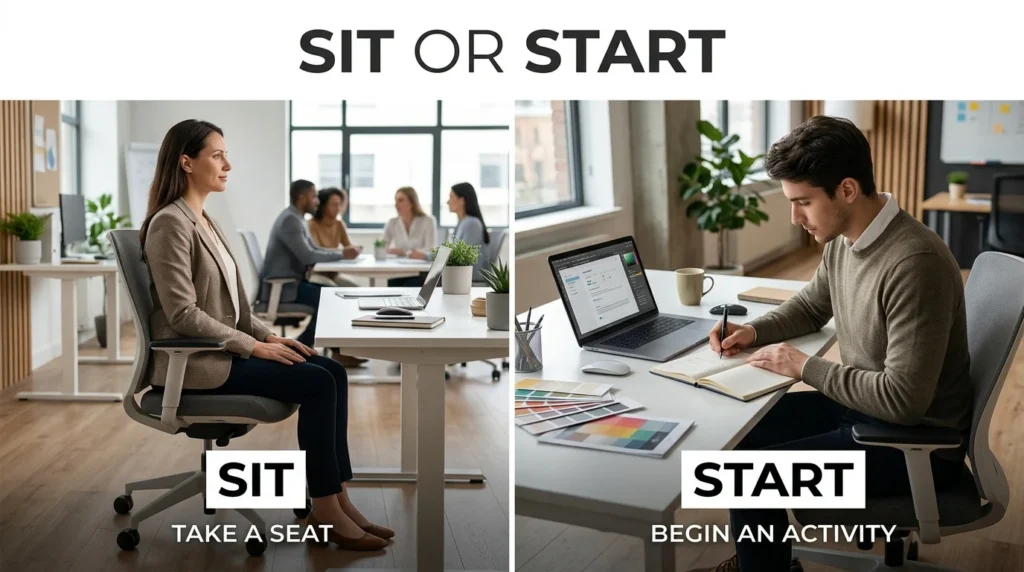

Quick Answer
Sit and start are both correct English words, but they have different meanings. Sit means to take or remain in a seated position, while start means to begin something.
The words sit and start are short, common verbs, but they cannot be used in the same way. A small mistake can change the meaning of a sentence completely. For example, “Please sit here” asks someone to take a seat, while “Please start here” tells someone to begin at a particular place or point.
These words are not different spellings of one word. They are separate verbs with separate meanings. Sit usually relates to position, rest, or being seated. Start usually relates to beginning an action, activity, event, process, or journey.
Learning the difference between sit or start will help you write clearer sentences in school, work, conversations, messages, and everyday situations.
Are Sit and Start Both Correct Words?
Yes. Sit and start are both correct English words.
The issue is not spelling. The issue is meaning.
Use sit when you mean:
- To take a seat
- To remain in a seated position
- To rest on a surface
- To stay in a particular place or position
Use start when you mean:
- To begin something
- To make something begin
- To turn on a machine or vehicle
- To begin a journey or activity
For example:
- Please sit on the sofa.
- Please start your homework.
Both sentences are correct, but they describe two different actions.
What Does Sit Mean?
Sit is a verb that usually means to place your body in a seated position or remain seated.
Examples:
- Please sit beside me.
- I like to sit near the window.
- The children sit quietly during the lesson.
- She wants to sit on the front row.
- We sat under a tree during lunch.
The word can describe a person, an animal, or sometimes an object that remains in a particular position.
For example:
- The dog is sitting near the door.
- The book is sitting on the desk.
- The house sits on top of a hill.
In ordinary conversation, however, sit most often refers to taking a seat or remaining in a seated position.
What Does Start Mean?
Start means to begin something or cause something to begin.
Examples:
- Let’s start the lesson.
- The movie will start at seven.
- I need to start my homework.
- She started a new job.
- The car would not start.
The word can describe activities, events, tasks, journeys, machines, businesses, and many other things.
For example:
- We will start the meeting soon.
- He wants to start a business.
- The train started moving.
- She started learning Spanish.
- The computer started after a few minutes.
The central meaning is beginning.
Sit or Start: Main Difference
The main difference is simple:
| Word | Meaning | Example |
|---|---|---|
| Sit | To take or remain in a seated position | Please sit here. |
| Start | To begin something | Please start the lesson. |
You can remember the difference this way:
Sit means take a seat.
Start means begin.
These words are not interchangeable.
Sit or Start in Simple Sentences
Look at these examples:
- Please sit down.
- Please start the meeting.
- I want to sit near the window.
- I want to start my project.
- She is sitting on the bench.
- She is starting a new course.
- We sat in the garden.
- We started the journey early.
The first word in each pair relates to position or rest. The second word relates to beginning an action.
When Should You Use Sit?
Use sit when someone needs to take a seat or remain seated.
Examples:
- Please sit here.
- You can sit beside me.
- The students sit quietly.
- I want to sit near the door.
- The baby is sitting on the floor.
- We sat around the table.
- The dog likes to sit by the window.
You can also use sit to describe something that stays in a place:
- The keys are sitting on the counter.
- A small cottage sits beside the lake.
- The old box has been sitting in the garage for years.
In each case, the idea is connected to position or remaining in one place.
When Should You Use Start?
Use start when something begins or when you want someone to begin an activity.
Examples:
- Start your work now.
- The class starts at nine.
- We should start the project today.
- The show started late.
- She started reading a new book.
- The engine started after several attempts.
- They started their trip before sunrise.
You can use start with a noun, an activity, or an action.
For example:
- start a meeting
- start a business
- start a conversation
- start a lesson
- start a project
- start a journey
- start working
- start reading
Why Do People Confuse Sit and Start?
People may confuse these words because both are short verbs that appear often in everyday writing. Fast typing, autocorrect, and unfamiliar sentence patterns can also cause mistakes.
However, the words do not have similar meanings.
Consider these sentences:
Please sit here.
This means that someone should take a seat in this location.
Please start here.
This means that someone should begin at this location or point.
The difference may seem small when the words appear alone, but the meaning changes as soon as they enter a sentence.
Sit in Everyday Conversation
The verb sit appears in many ordinary conversations.
Examples:
Come in and sit down.
Can I sit next to you?
We sat outside for an hour.
She is sitting in the waiting room.
Please sit still while I fix your hair.
The word is especially common when talking about chairs, sofas, benches, classrooms, restaurants, offices, and waiting areas.
You can also use it in a relaxed way:
I could sit here all afternoon.
This means that the speaker would enjoy remaining in that place.
Start in Everyday Conversation
The verb start is also very common in daily speech.
Examples:
What time does the movie start?
Let’s start dinner.
I need to start cleaning the house.
The rain started this morning.
When should we start?
My car will not start.
People use start when discussing schedules, tasks, plans, machines, events, and new activities.
It is often similar to begin, although start is very common in casual speech.
Sit or Start in School
Both words are useful in classroom situations.
Examples with sit:
- Please sit in your assigned seat.
- The students sat quietly.
- You may sit near the board.
- Everyone should sit before the teacher arrives.
Examples with start:
- The lesson will start soon.
- Please start your assignment.
- We will start the test at ten.
- The teacher started the class with a question.
A useful sentence may even contain both words:
Please sit down before we start the lesson.
Here, sit describes taking a seat, and start describes beginning the lesson.
Sit or Start in the Workplace
In a workplace, start is often used with meetings, tasks, projects, and schedules.
Examples:
- The meeting will start at three.
- Please start the report today.
- We started the project last week.
- The training session starts tomorrow.
- She started working for the company in June.
Sit is used when describing physical position or meetings in certain formal contexts.
Examples:
- Please sit in the conference room.
- The guests sat around the table.
- The manager asked everyone to sit down.
- The committee will sit again next month.
For most everyday workplace instructions, however, start the meeting is the natural phrase when you mean to begin it.
Sit or Start in Emails
The correct word depends on what you want the reader to do.
Use sit for seating instructions:
Please sit in the waiting area until your name is called.
You may sit near the entrance.
Use start for tasks or activities:
Please start the report before lunch.
The meeting will start at 2 p.m.
We can start the discussion after everyone arrives.
Using the wrong word can make an email sound confusing.
For example:
Please sit the meeting at ten.
This is incorrect if you mean that the meeting should begin.
The correct sentence is:
Please start the meeting at ten.
Sit or Start in Instructions
Instructions must use the verb that matches the intended action.
Use sit:
- Sit on the chair.
- Sit quietly.
- Sit near the window.
- Sit down and wait.
- Sit beside your partner.
Use start:
- Start the computer.
- Start the activity.
- Start the exercise.
- Start the timer.
- Start writing your answer.
Compare these two instructions:
Sit the timer.
This does not make sense in normal English.
Start the timer.
This is correct because the timer begins operating.
Sit or Start in Questions
Both words can appear in questions.
Questions with sit:
- Where should I sit?
- Can I sit here?
- Did you sit near the door?
- Why are you sitting on the floor?
- Will you sit with us?
Questions with start:
- When does the movie start?
- Should we start now?
- Did the class start already?
- What time will the event start?
- Can you start the machine?
The question form does not change the basic meaning of either word.
The Verb Forms of Sit
The verb sit has several important forms.
| Verb Form | Word | Example |
|---|---|---|
| Present | sit | I sit near the window. |
| Third-person present | sits | She sits beside me. |
| Past | sat | He sat on the bench. |
| Present participle | sitting | They are sitting outside. |
| Past participle | sat | She has sat there before. |
The past tense of sit is sat, not sitted.
Examples:
- I sit here every day.
- I sat here yesterday.
- She is sitting in the office.
- They have sat in this room before.
The Verb Forms of Start
The verb start follows a more regular pattern.
| Verb Form | Word | Example |
|---|---|---|
| Present | start | We start at eight. |
| Third-person present | starts | The show starts soon. |
| Past | started | The class started late. |
| Present participle | starting | We are starting now. |
| Past participle | started | They have started the project. |
Examples:
- I start work at nine.
- She starts school next week.
- We started the meeting early.
- They are starting a new business.
- He has started writing a book.
Common Mistakes With Sit
Here are some common mistakes involving sit.
Using Sit Instead of Sat
Incorrect:
I sit there yesterday.
Correct:
I sat there yesterday.
Use sat when describing a completed action in the past.
Using Sit Instead of Sitting
Incorrect:
She is sit on the sofa.
Correct:
She is sitting on the sofa.
After is, am, or are, use sitting when describing an action in progress.
Using Sit With the Wrong Meaning
Incorrect:
Please sit the lesson.
Correct:
Please start the lesson.
The lesson does not take a seat. It begins, so start is the correct verb.
Common Mistakes With Start
Here are some common mistakes involving start.
Using Start When You Mean Take a Seat
Incorrect:
Please start on the chair.
Correct:
Please sit on the chair.
Use sit when asking someone to take a seat.
Using Start Instead of Started
Incorrect:
The movie start yesterday.
Correct:
The movie started yesterday.
Use started for a completed action in the past.
Using Start Instead of Starting
Incorrect:
The event is start now.
Correct:
The event is starting now.
Use starting after is, am, or are when the action is in progress.
Sit Down and Start Out
The words can also appear in common phrases.
Sit Down
Sit down means to take a seated position.
Examples:
- Please sit down.
- We sat down for dinner.
- She sat down beside her friend.
Start Out
Start out means to begin a journey, activity, or situation.
Examples:
- We started out early in the morning.
- He started out as a teacher.
- The trip started out smoothly.
Sit Still
Sit still means to remain seated without moving much.
Example:
Please sit still while I take the picture.
Start Over
Start over means to begin again.
Example:
I made a mistake, so I will start over.
These phrases show that the two verbs can form different expressions with other words.
Can Sit and Start Appear in the Same Sentence?
Yes. In fact, using both words in one sentence can make the difference easier to understand.
Examples:
- Please sit down before we start the movie.
- We sat in the room until the meeting started.
- She is sitting outside while her brother is starting the car.
- Let’s sit together when the concert starts.
- The children sat quietly as the teacher started the lesson.
In these sentences, sit relates to position, while start relates to beginning.
Sit or Start: Real-Life Examples
At a Restaurant
Please sit at this table.
Dinner will start in a few minutes.
At a School
The students sat in their seats.
The test started at ten.
At an Office
Please sit in the waiting area.
The interview will start shortly.
At Home
I want to sit on the sofa.
I need to start cooking dinner.
During Travel
We sat near the window on the train.
The train started moving at six.
These examples show how both words work in natural situations.
A Simple Memory Trick
Use this quick test when you are unsure.
Ask yourself:
Do I mean “take a seat”?
If yes, use sit.
Ask yourself:
Do I mean “begin”?
If yes, use start.
For example:
- Please take a seat here.
→ Please sit here. - Please begin the lesson.
→ Please start the lesson.
This replacement trick can help you choose the correct word quickly.
Practice Questions
Choose sit, sat, sitting, start, started, or starting.
Questions
- Please ______ beside your friend.
- We ______ the movie at eight last night.
- She is ______ near the window.
- You should ______ your homework now.
- He ______ on the bench yesterday.
- The meeting will ______ soon.
- They are ______ a new project.
- Please ______ down and relax.
- The car finally ______.
- We have ______ the lesson.
Answers
- sit
- started
- sitting
- start
- sat
- start
- starting
- sit
- started
- started
The correct answer depends on both meaning and verb tense.
Sit or Start: Quick Grammar Review
Remember these rules:
- Sit means to take or remain in a seated position.
- Sat is the past tense of sit.
- Sitting describes an action in progress.
- Start means to begin something.
- Started is the past tense of start.
- Starting describes an action that is beginning or in progress.
- Use sit down when asking someone to take a seat.
- Use start when asking someone to begin a task or activity.
Do Sit and Start Have Different Spellings in British and American English?
No. Sit and start are spelled the same in British and American English.
The forms are also the same:
- sit
- sat
- sitting
- start
- started
- starting
The main issue is not regional spelling. It is choosing the word that expresses the correct meaning.
For example, both varieties use:
Please sit down.
They also both use:
The show will start at eight.
Final Tips
Keep these points in mind:
- Sit and start are both correct words.
- They are not alternative spellings of each other.
- Sit means to take or remain in a seated position.
- Start means to begin something.
- The past tense of sit is sat.
- The past tense of start is started.
- Use sitting for an action in progress.
- Use starting for an activity that is beginning.
- Use sit down when someone needs to take a seat.
- Use start when someone needs to begin a task.
- Both words have the same spelling in British and American English.
- When unsure, replace sit with “take a seat” and start with “begin.”
FAQs
What is the main difference between sit and start?
Sit means to take or remain in a seated position. Start means to begin something. For example, you can sit on a chair, but you can start a meeting.
Are sit and start different spellings of the same word?
No. They are two separate English verbs with different meanings. They are not spelling variations of one another.
Should I say “sit the meeting” or “start the meeting”?
You should say start the meeting when you mean to begin it. The phrase sit the meeting is not correct in ordinary English for that meaning.
What is the past tense of sit and start?
The past tense of sit is sat. The past tense of start is started. For example, “She sat on the chair” and “The movie started at seven.”
Do sit and start have different British and American spellings?
No. Both British and American English use sit and start with the same spellings. The difference is based on meaning, not regional spelling.
Conclusion
The words sit and start are both correct, but they express different ideas. Sit relates to taking a seat, remaining seated, or staying in a particular position. Start relates to beginning an action, event, task, journey, or process.
The easiest way to remember the difference is to connect sit with “take a seat” and start with “begin.” You can sit on a chair, sit near a window, or sit quietly. On the other hand, you can start a meeting, start a project, start a journey, or start a conversation.
These words have the same spellings in British and American English. Therefore, the most important step is to understand the meaning of the sentence and choose the verb that fits it.