
Many English learners struggle with has vs have because both words come from the same verb but are used in different situations. Although the difference may seem small, choosing the wrong form can make a sentence grammatically incorrect.
These words appear in everyday conversations, business communication, academic writing, social media posts, emails, and professional documents. Because they are used so often, understanding the correct usage is important for anyone learning or improving English.
The confusion usually happens because both words express possession, ownership, experience, or relationships. However, the subject of the sentence determines whether you should use has or have.
Learning this grammar rule is easier than many people think. Once you understand the subject agreement pattern, choosing the correct word becomes natural.
This guide explains has vs have in simple language. You will learn meanings, grammar rules, sentence structures, examples, common mistakes, real world usage, exercises, and frequently asked questions.
Quick Overview
Has is used with he, she, and it.
Have is used with I, you, we, and they.
Both words come from the verb have.
The correct choice depends on the subject of the sentence.
What Is Has
Has is a present tense form of the verb have.
It is used with singular third person subjects.
Examples:
- He has a new laptop.
- She has a beautiful garden.
- It has a strong engine.
In each example, the subject is singular, so has is correct.
What Is Have
Have is also a present tense form of the verb have.
It is used with I, you, we, and they.
Examples:
- I have a meeting today.
- You have excellent skills.
- We have enough time.
- They have several projects.
Because these subjects are not singular third person subjects, have is used.
Key Difference Between Has vs Have


4
The main difference is subject agreement.
Has works with:
- He
- She
- It
- Singular nouns
Have works with:
- I
- You
- We
- They
- Plural nouns
Quick Comparison Table
| Feature | Has | Have |
|---|---|---|
| Verb Type | Present tense | Present tense |
| Used With | He, She, It | I, You, We, They |
| Singular Nouns | Yes | No |
| Plural Nouns | No | Yes |
| Common Usage | Singular subjects | Plural subjects |
Understanding Subject Verb Agreement
Subject verb agreement is one of the most important grammar rules in English.
The verb must match the subject.
Examples:
- He has a car.
- They have a car.
The object remains the same, but the verb changes according to the subject.
Singular Subjects
Use has.
Examples:
- Sarah has a dog.
- The company has a new office.
- My friend has a bicycle.
Plural Subjects
Use have.
Examples:
- Sarah and Tom have a dog.
- The companies have new offices.
- My friends have bicycles.
Has vs Have in Everyday Conversation
People use has and have constantly in daily life.
Examples:
- She has a dentist appointment.
- We have lunch at noon.
- He has a new phone.
- They have vacation plans.
Correct usage makes communication sound natural and professional.
Has vs Have for Possession
One of the most common uses is showing ownership.
Examples with Has
- She has a car.
- He has a bicycle.
- The cat has a toy.
Examples with Have
- I have a car.
- We have bicycles.
- They have toys.
Possession is often the first use that students learn.
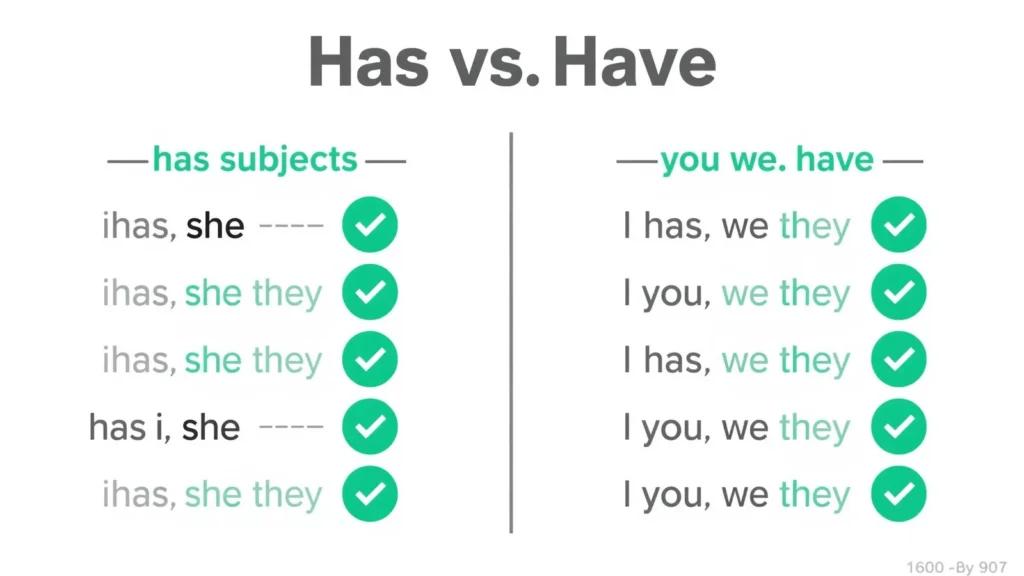
Visual Examples of Has and Have


5
These examples show how subjects determine whether has or have should be used.
Has vs Have in Present Perfect Tense
Has and have are also used as helping verbs in present perfect tense.
Has in Present Perfect
Examples:
- He has completed the project.
- She has arrived.
- It has stopped raining.
Have in Present Perfect
Examples:
- I have finished my homework.
- We have completed the report.
- They have arrived.
This is one of the most important uses in professional writing.
Has vs Have in Questions
Questions also follow subject agreement rules.
Examples with Has
- Has he arrived?
- Has she called?
- Has the package arrived?
Examples with Have
- Have you finished?
- Have they left?
- Have we met before?
Notice how the helping verb changes according to the subject.
Has vs Have in Negative Sentences
Negative sentences require has not or have not.
Has Not
Examples:
- He has not finished.
- She has not arrived.
- It has not started.
Have Not
Examples:
- I have not finished.
- We have not arrived.
- They have not started.
Short forms include:
- Has not = Hasn’t
- Have not = Haven’t
Common Mistakes With Has vs Have
Many learners make the same errors repeatedly.
Mistake One
Incorrect:
- He have a car.
Correct:
- He has a car.
Mistake Two
Incorrect:
- They has a car.
Correct:
- They have a car.
Mistake Three
Incorrect:
- She have completed the work.
Correct:
- She has completed the work.
Mistake Four
Incorrect:
- We has finished.
Correct:
- We have finished.
Avoiding these mistakes improves grammar significantly.
Real World Examples
Example One
A teacher speaks about a student.
Correct sentence:
- The student has excellent attendance.
Example Two
A manager speaks about employees.
Correct sentence:
- The employees have completed training.
Example Three
A parent speaks about a child.
Correct sentence:
- My son has a new backpack.
Example Four
Friends discuss plans.
Correct sentence:
- We have tickets for the concert.
Has vs Have in Academic Writing
Academic writing requires correct grammar.
Examples:
- The study has several limitations.
- Researchers have analyzed the data.
- The report has important findings.
- Scientists have conducted experiments.
Proper subject agreement increases credibility.
Has vs Have in Business Communication
Business professionals use these words every day.
Examples:
- The company has launched a new product.
- Employees have received training.
- The department has approved the proposal.
- Teams have completed their tasks.
Incorrect grammar can affect professionalism.
Has vs Have in Technology and Digital Communication
Technology related content frequently uses has and have.
Examples:
- The software has new features.
- Users have reported issues.
- The application has improved performance.
- Developers have released updates.
Technical writing depends on accurate grammar.
Visual Comparison of Common Mistakes


6
Learning common errors helps writers choose the correct form more confidently.
Advantages of Understanding Has vs Have
Better Grammar
Correct usage improves sentence structure.
Professional Writing
Business documents require proper grammar.
Stronger Communication
Readers understand your meaning clearly.
Better Academic Performance
Students avoid common grammar mistakes.
Improved Confidence
Speaking and writing become easier.
Disadvantages of Incorrect Usage
Using the wrong form can create problems.
Grammar Errors
Sentences become incorrect.
Poor Professional Impression
Readers may notice mistakes.
Reduced Clarity
Communication may become confusing.
Lower Academic Scores
Grammar mistakes can affect grades.
Related Grammar Concepts
Several grammar topics are connected to has vs have.
Subject Verb Agreement
The verb must match the subject.
Present Tense Verbs
Has and have are present tense forms.
Helping Verbs
Both words help create present perfect tense.
Singular and Plural Nouns
Subject number affects verb choice.
Regional and Global Usage
Has and have follow the same rules worldwide.
These rules apply in:
- American English
- British English
- Canadian English
- Australian English
- International English
The grammar does not change by region.
Beginner to Advanced Understanding
Beginner Level
Use has with he, she, and it.
Use have with I, you, we, and they.
Intermediate Level
Use has and have to show possession and relationships.
Advanced Level
Use has and have correctly in present perfect constructions, academic writing, business communication, and formal documents.
Exercises With Answers
Question One
Choose the correct word.
He ___ a bicycle.
Answer: Has
Question Two
Choose the correct word.
They ___ a bicycle.
Answer: Have
Question Three
Choose the correct word.
She ___ completed her work.
Answer: Has
Question Four
Choose the correct word.
We ___ completed our work.
Answer: Have
Question Five
Choose the correct word.
The company ___ launched a new product.
Answer: Has
Question Six
Choose the correct word.
The employees ___ received training.
Answer: Have
Question Seven
Choose the correct word.
It ___ stopped raining.
Answer: Has
Question Eight
Choose the correct word.
I ___ enough time.
Answer: Have
Question Nine
Choose the correct word.
My brother ___ a laptop.
Answer: Has
Question Ten
Choose the correct word.
My brothers ___ laptops.
Answer: Have
FAQs
What is the main difference between has vs have?
Has is used with he, she, it, and singular nouns. Have is used with I, you, we, they, and plural nouns.
Is has singular or plural?
Has is used with singular third person subjects.
Is have singular or plural?
Have is generally used with plural subjects and certain singular pronouns such as I and you.
Can has and have both show possession?
Yes. Both words can indicate ownership or possession.
Do has and have follow the same rules worldwide?
Yes. Standard English grammar rules remain consistent.
Can has and have be helping verbs?
Yes. They are used in present perfect tense.
Which is correct, he has or he have?
He has is correct.
Which is correct, they has or they have?
They have is correct.
Can I use have with a singular noun?
Generally no, unless the subject is I or you.
Why do learners confuse has and have?
Because both come from the same verb and express similar meanings.
Conclusion
Understanding has vs have is essential for clear and correct English communication. Although both words come from the verb have, they are used with different subjects. Has is used with he, she, it, and singular nouns, while have is used with I, you, we, they, and plural nouns.
These words appear in conversations, academic writing, business communication, technology content, and everyday life. Using the correct form improves grammar, professionalism, and confidence. It also helps readers understand your message without confusion.
A simple rule can help you remember the difference. If the subject is he, she, it, or a singular noun, use has. If the subject is I, you, we, they, or a plural noun, use have. Following this rule will help you write and speak English more accurately.