

Quick Answer
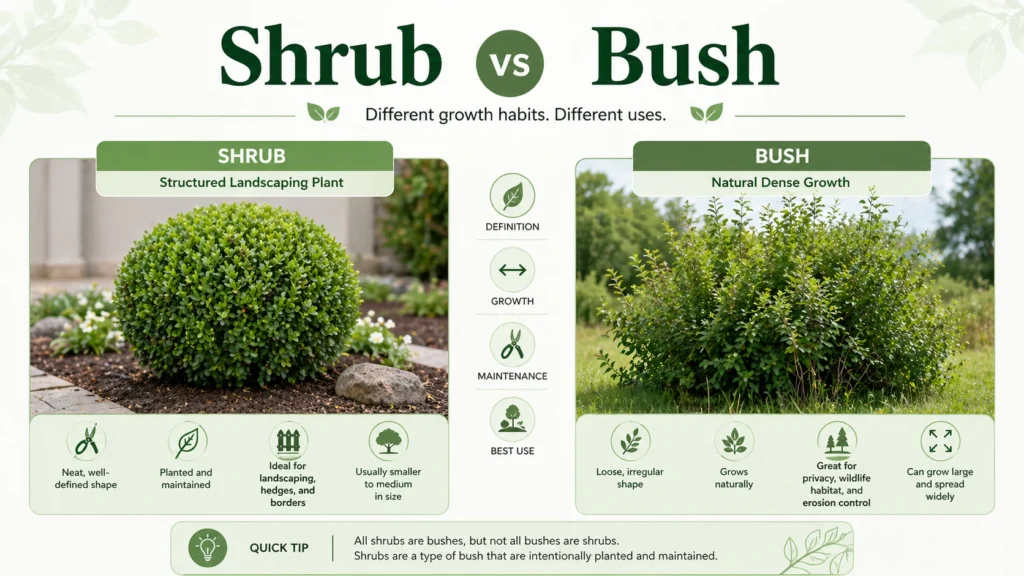
Shrub and bush are often used as similar terms, but they are not exactly the same. A shrub is a specific type of woody plant with multiple stems and a defined structure, while a bush is a more general, informal term used to describe dense, low growing plants. In simple words, all shrubs can be called bushes, but not all bushes are true shrubs.
Many people use the words shrub and bush as if they mean the same thing. You may hear someone say bush in casual talk, while gardening books often use the word shrub. This creates confusion for beginners, gardeners, and even homeowners.
Both shrubs and bushes are small to medium sized plants. They grow close to the ground and have multiple stems. However, there are subtle differences in structure, usage, and classification.
Understanding shrub vs bush is important if you are planning a garden, learning landscaping, or studying plant science. It helps you choose the right plants, describe them correctly, and care for them properly.
In this complete guide, you will learn everything about shrub vs bush in simple language. We will cover definitions, differences, plant structure, landscaping uses, real world examples, common mistakes, and expert insights.
Quick Overview
Shrub is a scientific and botanical term
Bush is an informal and general term
Shrubs have a defined growth pattern
Bushes grow more freely and irregularly
Both are small woody plants with multiple stems
Key Difference Between Shrub vs Bush


The main difference lies in structure and usage.
A shrub is more organized and classified in botany
A bush is a casual term used for dense plants
Shrubs are often trimmed and maintained
Bushes are usually allowed to grow naturally
Comparison Table
| Feature | Shrub | Bush |
|---|---|---|
| Term type | Scientific | Informal |
| Structure | Defined | Irregular |
| Growth | Controlled | Natural |
| Use | Landscaping | General description |
| Example | Rose shrub | Wild bush |
Definition of Shrub
A shrub is a woody plant that is smaller than a tree. It usually has multiple stems and grows close to the ground. Shrubs often have a clear shape and structure.
Gardeners use shrubs for decoration, borders, and landscaping design. They can be trimmed and shaped easily.
Examples include rose shrubs, lavender shrubs, and boxwood shrubs.
Definition of Bush
A bush is a general term used to describe a plant that is thick and full. It does not have a strict scientific definition.
People often use bush to describe plants that grow naturally without much trimming. Bushes may look less organized compared to shrubs.
For example, a wild berry plant growing in a field may be called a bush.
Plant Structure Differences
Shrubs have a more organized structure. They grow in a planned way and can be shaped.
Bushes grow in a more natural and uncontrolled way. Their branches may spread randomly.
This difference makes shrubs better for formal gardens and bushes better for natural landscapes.
Growth Patterns and Size
Shrubs usually grow between one to six meters tall. They have controlled growth and can be maintained easily.
Bushes can vary widely in size. Some remain small, while others spread widely and become dense.
Landscaping Uses
Shrubs in Landscaping
- Used for garden design
- Create borders and hedges
- Add beauty and structure
- Easy to trim and shape
Bushes in Landscaping
- Used for natural look
- Provide shelter for wildlife
- Require less maintenance
- Grow freely
Types of Shrubs
Shrubs come in many types based on their features.
Flowering Shrubs
These produce beautiful flowers such as roses and hydrangeas.
Evergreen Shrubs
These stay green all year like boxwood.
Deciduous Shrubs
These lose leaves in certain seasons.
Types of Bushes
Bushes are less formally classified but can include:
- Wild bushes
- Berry bushes
- Decorative bushes
These plants often grow naturally without strict care.
Real World Examples
1 Example One Garden Design
A homeowner plants boxwood shrubs to create a neat hedge.
2 Example Two Natural Area
A forest edge has wild berry bushes growing freely.
3 Example Three Landscaping Choice
A designer chooses shrubs for structure and bushes for a natural look.
Environmental Role
Both shrubs and bushes play important roles in nature.
They provide shelter for animals
They help prevent soil erosion
They support biodiversity
Bushes especially support wildlife in natural areas.
Advantages and Disadvantages
Advantages of Shrubs
- Easy to shape
- Improve garden design
- Controlled growth
Disadvantages
- Require maintenance
- Need regular trimming
Advantages of Bushes
- Low maintenance
- Natural growth
- Good for wildlife
Disadvantages
- Can look messy
- Hard to control
Common Mistakes
1 Mistake One Thinking They Are Completely Different
Correction They are very similar, but differ in usage
2 Mistake Two Using Terms Incorrectly
Correction Shrub is formal, bush is informal
3 Mistake Three Ignoring Maintenance Needs
Correction Shrubs need more care than bushes
Related Comparisons
Tree vs Shrub
Trees are taller with a single trunk
Plant vs Tree
Plants include all types, trees are one category
Shrub vs Herb
Herbs are small and non woody
Beginner to Advanced Understanding
Beginner Level
Shrub is a formal term
Bush is a general term
Intermediate Level
Shrubs are structured and used in landscaping
Bushes are natural and less controlled
Advanced Level
Botanical classification uses shrub, while bush is a descriptive term used in everyday language
Regional and Global Usage
In gardening books and scientific studies, shrub is commonly used.
In everyday language, people often say bush.
Different regions may prefer one term over the other.
Care and Maintenance
Shrubs require pruning, watering, and shaping.
Bushes need less maintenance and can grow naturally.
Proper care depends on the plant type and purpose.
Exercises With Answers
One Question
Which term is scientific
Answer Shrub
Two Question
Which grows naturally
Answer Bush
Three Question
Which is used in landscaping
Answer Shrub
Four Question
Which needs more maintenance
Answer Shrub
Five Question
Which term is informal
Answer Bush
FAQs
Is shrub vs bush the same?
They are similar, but shrub is a scientific term while bush is informal.
Can all shrubs be called bushes?
Yes, but not all bushes are true shrubs.
Which is better for gardens?
Shrubs are better for structured gardens.
Do bushes need trimming?
Usually less than shrubs.
Are shrubs bigger than bushes?
Not always, size can vary.
Why do gardeners use shrub instead of bush?
Because it is more accurate and scientific.
Can a bush become a shrub?
If it is maintained and shaped, it may be considered a shrub.
Which is more natural?
Bushes are more natural in growth.
Conclusion
Understanding shrub vs bush helps you use the correct terms and make better gardening choices. A shrub is a structured and scientifically recognized plant, while a bush is a general term used for dense plants.
Shrubs are ideal for landscaping and design because they can be shaped and maintained. Bushes are better for natural environments where plants grow freely.
Both play important roles in gardens and ecosystems. Choosing between them depends on your needs, whether you want a neat garden or a natural look.