
Quick Answer
Ceramics and pottery are closely related but not the same. Ceramics is a broad term for all objects made from clay and hardened by heat, while pottery is a specific type of ceramics used mainly for making pots, bowls, and other functional items.
Many people confuse ceramics vs pottery because both involve clay and heat. At first glance, they look the same. However, there is a clear difference between them.
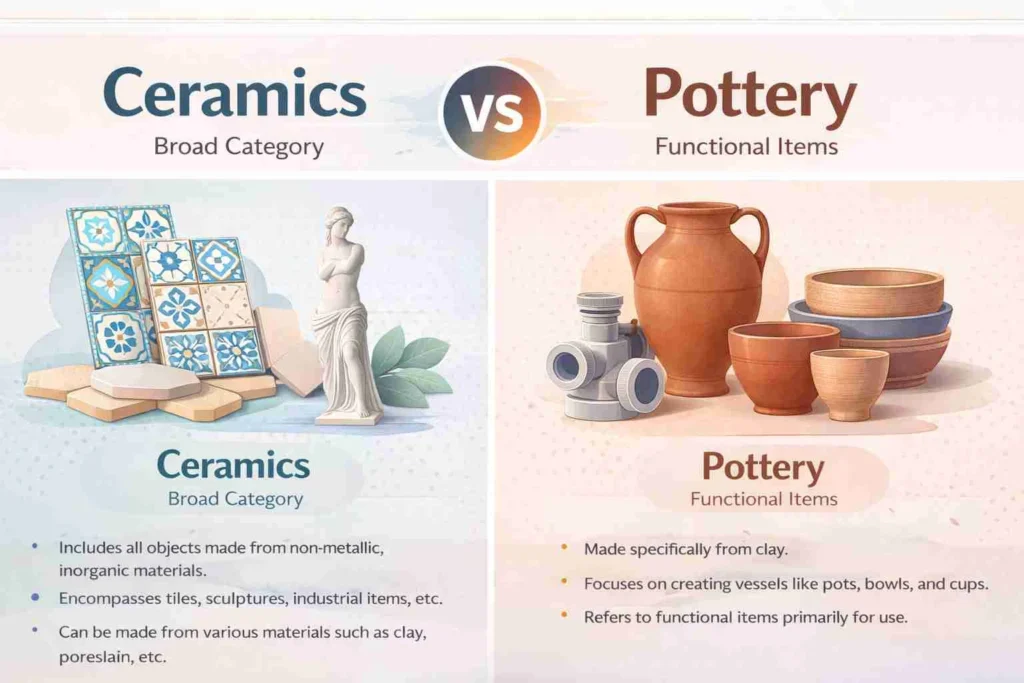
Ceramics is a wide category. It includes everything made from clay and fired in a kiln. This can include tiles, bricks, sculptures, and even advanced materials used in technology. On the other hand, pottery is a smaller category within ceramics. It mainly refers to everyday items like pots, bowls, and cups.
Understanding ceramics vs pottery is important for artists, students, and anyone interested in crafts or design. It helps you choose the right term and understand how these materials are used in real life.
In this guide, you will learn the full difference in simple language. We will cover types, techniques, uses, examples, mistakes, and much more.
Quick Overview
Ceramics is a broad category of clay based materials
Pottery is a type of ceramics focused on containers
Ceramics includes art and industrial products
Pottery mainly includes functional household items
Key Difference Between Ceramics vs Pottery


4
The main difference lies in scope and purpose.
Ceramics includes all clay based objects hardened by heat
Pottery focuses on making containers like pots and bowls
Comparison Table
| Feature | Ceramics | Pottery |
|---|---|---|
| Meaning | Broad category | Specific type |
| Scope | Wide | Narrow |
| Items | Tiles, bricks, art | Pots, bowls, cups |
| Usage | Art and industry | Household use |
| Technique | Various methods | Mainly wheel or hand forming |
What Is Ceramics
Ceramics refers to any object made from clay and hardened by heat. This includes both artistic and industrial items.
Examples of ceramics include:
- Tiles
- Bricks
- Plates
- Sculptures
- Advanced materials
Ceramics can be decorative, functional, or technical.
What Is Pottery
Pottery is a type of ceramics that focuses on making containers and vessels.
Common pottery items include:
- Pots
- Bowls
- Cups
- Jars
Pottery is often handmade using a wheel or by shaping clay by hand.
Types of Ceramics
Ceramics can be divided into different types.
Traditional Ceramics
- Earthenware
- Stoneware
- Porcelain
Advanced Ceramics
- Heat resistant materials
- Medical implants
- Electrical components
This shows that ceramics go far beyond simple pottery.
Types of Pottery
Pottery also has different forms.
- Earthenware pottery
- Stoneware pottery
- Porcelain pottery
Each type differs in strength, texture, and temperature resistance.
How Ceramics Are Made


The process includes:
- Preparing clay
- Shaping
- Drying
- Firing in kiln
- Glazing
Ceramics may involve advanced techniques depending on use.
How Pottery Is Made


Pottery is usually made by:
- Shaping clay by hand or wheel
- Drying the item
- Firing in kiln
- Adding glaze
The process is simpler compared to advanced ceramics.
Main Differences Explained
The easiest way to understand ceramics vs pottery is:
Ceramics is the full category
Pottery is a part of it
Ceramics includes industrial and artistic items
Pottery mainly includes household containers
Advantages and Disadvantages
Ceramics Advantages
Wide range of uses
Strong and heat resistant
Used in industry and technology
Ceramics Disadvantages
Can be expensive
Requires complex processes
Pottery Advantages
Simple and traditional
Useful for daily life
Artistic and handmade
Pottery Disadvantages
Less durable than advanced ceramics
Limited uses
Real World Examples
1 Example: Home Use
A ceramic tile floor is ceramics, but not pottery
2 Example: Kitchen Use
A clay pot used for cooking is pottery
3 Example: Industry
Ceramic materials used in electronics are not pottery
Common Mistakes
1 Mistake Thinking They Are the Same
Correction Pottery is only a part of ceramics
2 Mistake Using Terms Incorrectly
Correction Use ceramics for broader category
3 Mistake Ignoring Industrial Use
Correction Ceramics include advanced materials
Related Comparisons
Clay vs Ceramics
Clay is raw material, ceramics is finished product
Porcelain vs Pottery
Porcelain is a type of ceramic, not all pottery
Art vs Craft
Ceramics can be both art and industrial material
Beginner to Advanced Understanding
Beginner Level
Ceramics is big category
Pottery is part of it
Intermediate Level
Ceramics includes many products
Pottery focuses on containers
Advanced Level
Ceramics includes advanced materials used in science and engineering
Regional and Global Usage
Ceramics are used worldwide in construction and industry
Pottery is found in every culture as a traditional craft
Different regions have unique pottery styles
Exercises With Answers
1 Question
Is pottery part of ceramics
Answer Yes
2 Question
Which is broader ceramics or pottery
Answer Ceramics
3 Question
Name one pottery item
Answer Bowl
4 Question
Are tiles pottery
Answer No they are ceramics
5 Question
Which is used in industry
Answer Ceramics
FAQs
Are ceramics and pottery the same?
No, pottery is a type of ceramics
Is all pottery ceramics?
Yes, all pottery belongs to ceramics
Can ceramics be used in industry?
Yes, ceramics are widely used in technology
What is pottery mainly used for?
Pottery is used for making containers and utensils
Is pottery handmade?
Often yes, but it can also be machine made
Are ceramic tiles pottery?
No, they are ceramics but not pottery
Which is stronger ceramics or pottery?
Advanced ceramics are stronger
Why is pottery important?
It is useful for daily life and art
Conclusion
Understanding ceramics vs pottery is simple when you know the scope. Ceramics is a broad category that includes all clay based objects hardened by heat. Pottery is a smaller part of ceramics that focuses on making containers like pots and bowls.
Ceramics includes both traditional items and advanced materials used in industry. Pottery is more focused on everyday use and artistic creation. Knowing this difference helps you use the correct terms and understand their applications.
In short, all pottery is ceramics, but not all ceramics is pottery. This simple idea makes the difference clear and easy to remember.