
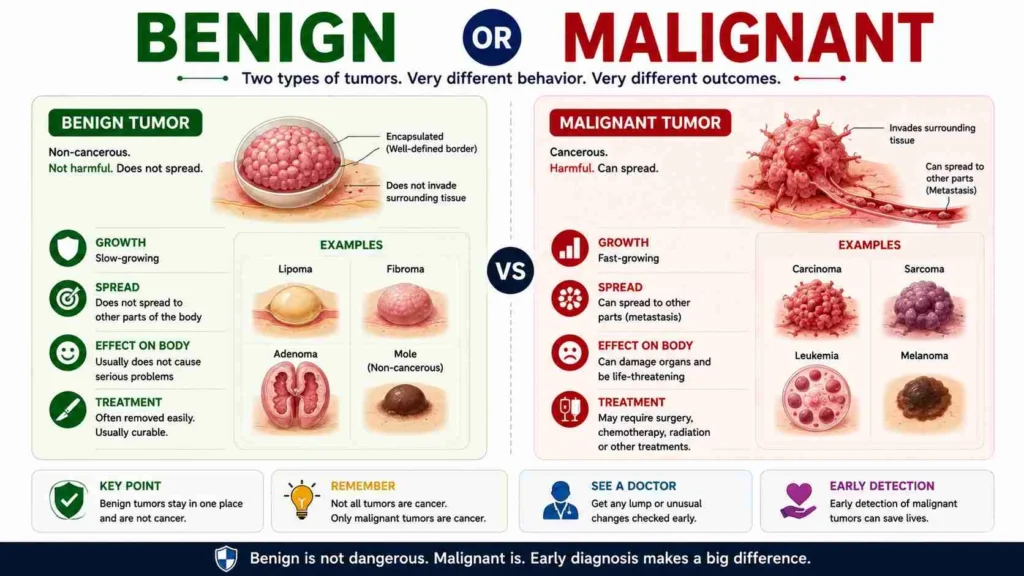

Many people feel worried after hearing the words benign or malignant during a medical test or doctor visit. These terms are commonly used to describe tumors, lumps, or abnormal growths in the body. Although they sound similar, they have very different meanings.
A benign tumor is usually harmless and does not spread to nearby tissues. On the other hand, a malignant tumor is cancerous and may spread to other organs through the blood or lymph system. Because of this difference, understanding benign or malignant is very important for health awareness and early treatment.
Doctors use scans, biopsies, and laboratory tests to determine whether a growth is benign or malignant. Early diagnosis often improves treatment success and reduces complications.
This guide explains benign or malignant in simple language. You will learn about definitions, causes, symptoms, diagnosis, treatment options, real life examples, common mistakes, and medical insights.
Quick Overview
Benign tumors are non cancerous and usually slow growing.
Malignant tumors are cancerous and can spread to other body parts.
Benign growths are often less dangerous.
Malignant growths require immediate medical attention.
Both types may need medical evaluation.
Key Difference Between Benign or Malignant


The main difference is that benign tumors stay in one place, while malignant tumors can spread throughout the body.
Benign tumors grow slowly and remain localized.
Malignant tumors grow rapidly and invade nearby tissues.
What Is a Benign Tumor
A benign tumor is a non cancerous growth of abnormal cells. These tumors usually grow slowly and stay in one location.
Most benign tumors do not threaten life. However, some can still cause problems if they press on nearby organs, nerves, or blood vessels.
Characteristics of Benign Tumors
- Slow growth
- Do not spread
- Often enclosed in a capsule
- Usually less dangerous
Common examples include lipomas, fibroids, and some skin moles.
What Is a Malignant Tumor
A malignant tumor is a cancerous growth that can invade nearby tissues and spread to other parts of the body.
This spreading process is called metastasis. Because of this ability, malignant tumors are more dangerous and require quick treatment.
Characteristics of Malignant Tumors
- Fast growth
- Spread to other organs
- Damage nearby tissues
- Can become life threatening
Examples include lung cancer, breast cancer, and colon cancer.
Visual Difference Between Benign and Malignant Tumors


Benign tumors usually have smooth borders and stay contained.
Malignant tumors often have irregular shapes and spread into nearby tissues.
Comparison Table
| Feature | Benign | Malignant |
|---|---|---|
| Cancerous | No | Yes |
| Growth speed | Slow | Fast |
| Spread to other organs | No | Yes |
| Threat level | Usually low | High |
| Border shape | Smooth | Irregular |
| Recurrence | Less common | More common |
Causes of Benign or Malignant Tumors
Tumors develop when cells grow abnormally. Several factors may increase risk.
Common Causes
- Genetic mutations
- Smoking
- Radiation exposure
- Poor lifestyle habits
- Environmental toxins
- Family history
Not all tumors develop for the same reason. Sometimes the exact cause remains unknown.
Symptoms of Benign or Malignant Growths
Symptoms depend on the size and location of the tumor.
Symptoms of Benign Tumors
- Small lump under skin
- Mild pressure or discomfort
- Slow changes over time
Symptoms of Malignant Tumors
- Rapid growth
- Unexplained weight loss
- Fatigue
- Persistent pain
- Bleeding or unusual discharge
How Doctors Diagnose Benign or Malignant Tumors


Doctors use different methods to determine whether a tumor is benign or malignant.
Diagnostic Methods
- Physical examination
- Ultrasound
- MRI scan
- CT scan
- Biopsy
- Blood tests
A biopsy is one of the most important tests because it examines cells directly.
Treatment Options
Treatment for Benign Tumors
Some benign tumors do not require treatment. However, doctors may remove them if they cause pain or pressure.
Common treatments include:
- Monitoring
- Surgery
- Medication in some cases
Treatment for Malignant Tumors
Malignant tumors often require aggressive treatment.
Common options include:
- Surgery
- Chemotherapy
- Radiation therapy
- Immunotherapy
- Targeted therapy
Early treatment improves survival rates.
Real World Examples
Example One Benign Lipoma
A person notices a soft lump under the skin. Doctors diagnose it as a benign lipoma that does not spread.
Example Two Malignant Breast Cancer
A patient finds a fast growing lump in the breast. Testing confirms malignant cancer requiring surgery and treatment.
Example Three Brain Tumor
Some brain tumors are benign but still dangerous because they press on important brain structures.
Advantages and Disadvantages of Early Detection
Advantages
- Faster treatment
- Better recovery chances
- Reduced complications
- Less emotional stress
Disadvantages of Delayed Diagnosis
- Disease progression
- Spread of cancer
- More difficult treatment
Common Mistakes About Benign or Malignant
Mistake One Thinking Benign Means Harmless
Correction
Some benign tumors can still cause serious problems depending on location.
Mistake Two Assuming All Tumors Are Cancer
Correction
Many tumors are benign and non cancerous.
Mistake Three Ignoring Symptoms
Correction
Persistent lumps or unusual symptoms should always be checked by a doctor.
Mistake Four Believing Malignant Always Means Untreatable
Correction
Many malignant cancers are treatable when detected early.
Related Comparisons
Cyst vs Tumor
A cyst is usually fluid filled, while a tumor involves abnormal cell growth.
Cancer vs Benign Growth
Cancer spreads and invades tissues. Benign growths stay localized.
Stage vs Grade of Cancer
Stage describes spread. Grade describes how abnormal the cells appear.
Beginner to Advanced Understanding
Beginner Level
Benign means non cancerous.
Malignant means cancerous.
Intermediate Level
Benign tumors stay localized, while malignant tumors spread to nearby organs.
Advanced Level
Malignant tumors invade tissues through uncontrolled cellular mutation and metastasis, while benign tumors usually remain encapsulated.
Regional and Global Impact
Cancer affects millions of people worldwide. Early screening programs help identify malignant tumors sooner.
Developed countries often provide advanced diagnostic tools. In contrast, limited healthcare access in some regions can delay diagnosis and treatment.
Awareness about benign or malignant conditions improves survival and public health outcomes.
Emotional and Psychological Effects
Hearing the word tumor often creates fear and anxiety. Many people immediately think of cancer.
However, understanding the difference between benign or malignant helps reduce unnecessary panic. Clear communication from doctors and early testing provide reassurance and guidance.
Family support and counseling can also help patients manage stress during diagnosis and treatment.
Lifestyle and Prevention Tips
Although not all tumors are preventable, healthy habits reduce risk.
Prevention Tips
- Avoid smoking
- Exercise regularly
- Eat balanced meals
- Reduce alcohol intake
- Attend regular medical checkups
- Protect skin from excessive sunlight
Healthy living supports overall wellness and lowers cancer risk.
Exercises With Answers
Question One
Which tumor type is cancerous
Answer Malignant
Question Two
Do benign tumors spread
Answer No
Question Three
What test confirms tumor type
Answer Biopsy
Question Four
Can benign tumors still cause problems
Answer Yes
Question Five
Which tumor grows aggressively
Answer Malignant
FAQs
What does benign mean?
Benign means non cancerous and usually slow growing.
What does malignant mean?
Malignant means cancerous and capable of spreading.
Can a benign tumor become malignant?
Some rare benign tumors may later become cancerous.
Are all malignant tumors deadly?
No, many are treatable with early diagnosis and proper treatment.
How do doctors identify benign or malignant tumors?
Doctors use scans, biopsies, and laboratory tests.
Can benign tumors cause pain?
Yes, especially if they press on nearby tissues.
Do malignant tumors spread quickly?
Many malignant tumors can spread aggressively if untreated.
What is metastasis?
Metastasis is the spread of cancer cells to other body parts.
Is surgery needed for benign tumors?
Not always. Some only require monitoring.
Why is early diagnosis important?
Early treatment improves recovery and survival rates.
Conclusion
Understanding benign or malignant is essential for medical awareness and early healthcare decisions. Benign tumors are non cancerous and usually remain in one place. Malignant tumors are cancerous and can spread to other organs, making them more dangerous.
Although benign growths are often less serious, they may still require treatment depending on size and location. Malignant tumors require immediate medical attention because early diagnosis improves treatment success and survival rates.
Doctors use imaging tests, biopsies, and physical examinations to identify tumor types accurately. Therefore, people should never ignore unusual lumps, pain, or unexplained symptoms.
Learning the difference between benign or malignant helps reduce fear, improve awareness, and encourage timely medical care.