

Quick Answer
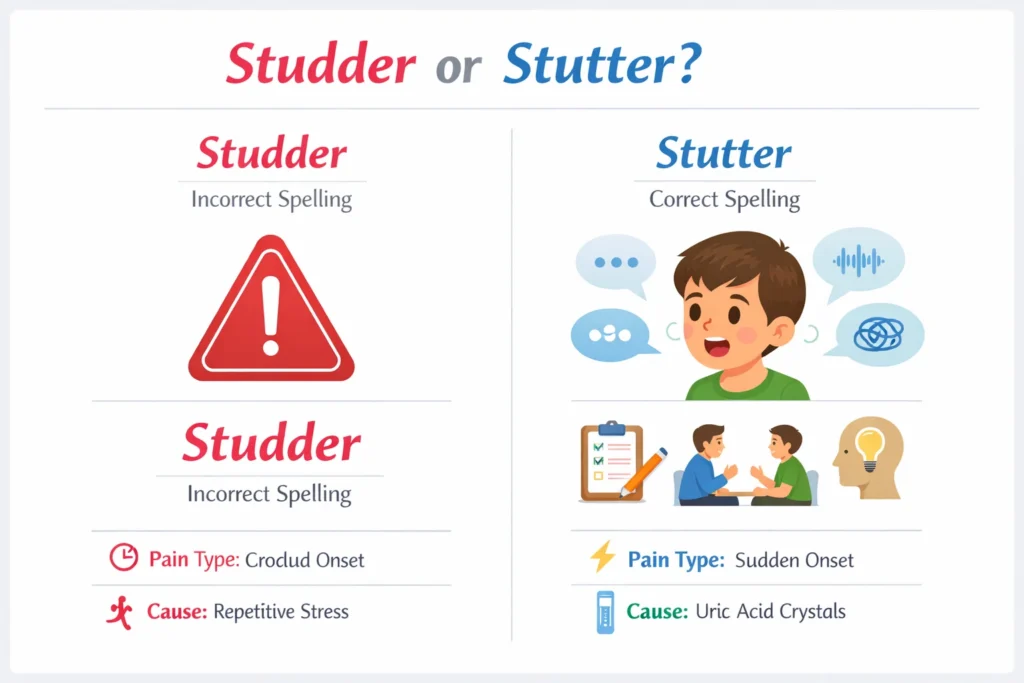
Stutter and studder refer to the same speech condition involving repeated sounds, pauses or difficulty speaking smoothly. However, stutter is the correct and widely accepted spelling in modern English, while studder is considered a misspelling or outdated variation.
Many people become confused when they see the words studder and stutter online. Both words sound similar, and many people accidentally use studder while typing or searching. However, only one spelling is considered correct in standard English.
The correct spelling is stutter. It describes a speech disorder that causes repeated sounds, pauses, or interruptions during speaking. On the other hand, studder is generally treated as a spelling mistake or a nonstandard variation.
Understanding studder or stutter is important for students, writers, teachers, parents, and anyone learning English. Using the correct spelling improves writing quality, communication, and professionalism. It also helps people search for accurate medical and educational information.
This guide explains everything about studder or stutter in simple language. You will learn spelling rules, pronunciation, meanings, grammar usage, medical explanations, common mistakes, examples, speech therapy information, FAQs, and much more.
Quick Overview
Stutter is the correct English spelling.
Studder is usually considered incorrect.
Stutter refers to a speech disorder.
Studder is mostly a typing or spelling error.
Medical professionals, teachers, and dictionaries use stutter.
Key Difference Between Studder or Stutter


4
The main difference is spelling accuracy.
Stutter is the accepted word in English dictionaries and medical terminology.
Studder is not considered standard English and is usually treated as a misspelling.
Comparison Table
| Feature | Stutter | Studder |
|---|---|---|
| Correct spelling | Yes | No |
| Dictionary accepted | Yes | Rarely |
| Medical use | Yes | No |
| Common online typo | No | Yes |
| Meaning | Speech disorder | Misspelling of stutter |
What Does Stutter Mean
Stutter is a speech disorder that affects the flow of speaking. A person who stutters may repeat sounds, pause unexpectedly, or struggle to pronounce words smoothly.
For example:
“I w w want to go home.”
The condition can affect children and adults. Some people experience mild stuttering, while others face more severe communication difficulties.
What Does Studder Mean
Studder does not have official recognition in most modern dictionaries. In most cases, people use it accidentally instead of stutter.
Sometimes, old texts or informal online posts may contain the spelling studder, but professional writing avoids it.
Therefore, when comparing studder or stutter, the correct spelling is clearly stutter.
History of the Word Stutter
The word stutter has existed in English for many centuries. It developed from older Germanic language roots related to interrupted speech.
Over time, dictionaries standardized the spelling as stutter. Because of pronunciation differences, some people mistakenly began writing studder.
However, grammar experts and language authorities continue to recognize stutter as the correct form.
Why People Confuse Studder or Stutter
Many people confuse these words because they sound similar during pronunciation.
Several reasons cause the confusion:
- Fast pronunciation
- Typing mistakes
- Autocorrect issues
- Limited spelling knowledge
- Hearing the word incorrectly
Because English spelling can be confusing, mistakes like studder often appear online.
Understanding Stuttering as a Speech Disorder
Stuttering is more than a simple speech mistake. It is a communication disorder that affects speaking rhythm and fluency.
People who stutter may experience:
- Repeated sounds
- Long pauses
- Blocked speech
- Anxiety during speaking
The condition often begins during childhood.
Types of Stuttering
Developmental Stuttering
This type appears during childhood while language skills develop.
Neurogenic Stuttering
This occurs after brain injury or neurological conditions.
Psychogenic Stuttering
This rare form may relate to emotional or psychological trauma.
Symptoms of Stuttering
Common symptoms include:
- Repeating words
- Repeating sounds
- Difficulty starting sentences
- Long pauses
- Facial tension while speaking
Some people also avoid speaking situations because of embarrassment.
Causes of Stuttering
Researchers believe several factors contribute to stuttering.
Genetics
Stuttering often runs in families.
Brain Function Differences
Speech coordination may work differently in people who stutter.
Emotional Stress
Stress does not directly cause stuttering, but it can worsen symptoms.
Developmental Factors
Young children may struggle while learning complex speech patterns.
Real World Examples of Stuttering
1 Example One School Presentation
A student repeats words while speaking in class because of stuttering.
2 Example Two Job Interview
An adult experiences speech blocks during an interview.
3 Example Three Public Speaking
A speaker pauses frequently while trying to pronounce difficult words.
These examples show how stuttering can affect daily life.
Difference Between Stuttering and Normal Speech Mistakes
Everyone makes speech mistakes sometimes. However, stuttering involves repeated disruptions in fluency.
Normal mistakes happen occasionally.
Stuttering happens regularly and may affect confidence and communication.
Emotional Impact of Stuttering
Stuttering can affect emotional wellbeing.
Some people feel:
- Anxiety
- Frustration
- Embarrassment
- Social fear
Support from family, teachers, and therapists can improve confidence.
Speech Therapy and Treatment
Speech therapy is one of the most effective treatments for stuttering.
Common Therapy Methods
- Slow speaking practice
- Breathing exercises
- Confidence building
- Speech rhythm training
Therapists help people improve fluency and communication skills.
Importance of Early Support
Children who receive early support often improve more quickly.
Parents should encourage calm communication and avoid criticizing speech mistakes.
Positive support creates confidence.
Common Mistakes When Using Studder or Stutter
Mistake One Using Studder in Formal Writing
Correction
Use stutter because it is the correct spelling.
Mistake Two Thinking Stuttering Means Low Intelligence
Correction
Stuttering has no connection with intelligence.
Mistake Three Mocking Speech Difficulties
Correction
People who stutter deserve patience and respect.
Grammar and Language Rules
English dictionaries, style guides, and educational systems recognize stutter as correct.
Examples:
Correct
He began to stutter during the speech.
Incorrect
He began to studder during the speech.
Regional and Global Usage
The word stutter is used internationally in English speaking countries.
American English uses stutter.
British English also uses stutter.
No major English standard officially prefers studder.
Stuttering in Children vs Adults
Children
Stuttering often begins between ages two and six.
Adults
Adult stuttering may continue from childhood or result from neurological conditions.
Social Misunderstandings About Stuttering
Some people wrongly assume that stuttering happens because of nervousness alone.
In reality, stuttering is a complex neurological and developmental condition.
Education helps reduce misunderstanding and bullying.
Famous People Who Stuttered
Several famous individuals experienced stuttering, including actors, leaders, and public speakers.
Their success proves that stuttering does not limit intelligence or achievement.
Advantages of Understanding Correct Usage
Learning the correct spelling improves:
- Grammar accuracy
- Writing professionalism
- Communication clarity
- Search engine results
- Academic performance
Related Comparisons
Speech disorder vs language disorder
Fluency vs pronunciation
Accent vs speech impairment
Grammar mistake vs spelling mistake
Beginner to Advanced Understanding
Beginner Level
Stutter is correct
Studder is incorrect
Intermediate Level
Stuttering affects speech fluency and communication.
Advanced Level
Neurological, genetic, emotional, and developmental factors influence stuttering patterns.
Practical Writing Tips
Always use stutter in:
- School assignments
- Medical writing
- Blog articles
- Professional communication
Avoid using studder unless discussing spelling mistakes.
Exercises With Answers
One Question
Which spelling is correct
Answer Stutter
Two Question
What does stutter describe
Answer A speech disorder
Three Question
Is studder accepted in standard English
Answer No
Four Question
Can children stutter
Answer Yes
Five Question
Does stuttering affect intelligence
Answer No
FAQs
Is studder or stutter correct?
Stutter is the correct spelling in modern English.
Why do people write studder?
Because pronunciation and typing mistakes create confusion.
What is a stutter?
It is a speech disorder that affects speaking fluency.
Is stuttering common in children?
Yes, many children experience temporary stuttering.
Can adults stutter?
Yes, adults can also stutter.
Does stress cause stuttering?
Stress may worsen symptoms but usually does not directly cause the condition.
Can speech therapy help stuttering?
Yes, speech therapy often improves communication skills.
Is stutter a disability?
Severe stuttering can affect communication and daily life.
Do all children outgrow stuttering?
No, some continue into adulthood.
Should teachers correct stuttering harshly?
No, supportive communication works better.
Conclusion
Understanding studder or stutter is important for correct grammar and respectful communication. Stutter is the correct spelling recognized by dictionaries, teachers, and medical professionals. Studder is usually considered a spelling mistake or nonstandard variation.
Beyond spelling, stuttering is a real speech disorder that affects millions of people worldwide. It can influence communication, confidence, and emotional wellbeing. However, support, therapy, and understanding can greatly improve fluency and self confidence.
When writing professionally or academically, always use stutter. At the same time, remember that people who stutter deserve patience, respect, and encouragement rather than criticism.