


Quick Answer:
Dived and dove are both correct past tense forms of the verb dive. However, dived is the traditional and more widely accepted form in British English and formal writing, while dove is more common in American English. Both words mean the same thing and describe the action of jumping or plunging into water or moving downward quickly.
Many English learners and writers get confused about dived vs dove. The two words look different, but both describe the past tense of the verb dive. Because English has regional spelling and grammar variations, both forms exist and are correct.
The confusion usually comes from differences between British English and American English. In many dictionaries and grammar guides, dived is considered the standard form. However, American speakers often use dove in everyday conversation and storytelling.
Understanding dived vs dove is important for students, bloggers, writers, and professionals who want to write clearly and correctly. Choosing the right form depends on your audience, writing style, and context.
In this guide, you will learn the meaning of both forms, their differences, usage rules, real world examples, common mistakes, and professional writing tips.
Definition of Dived
Dived is the traditional past tense and past participle of the verb dive. It describes the action of jumping into water or moving downward quickly.
Examples
She dived into the swimming pool.
The bird dived toward the ocean to catch a fish.
Most grammar experts and dictionaries accept dived as the safest form in formal writing.
Definition of Dove
Dove is an alternative past tense form of dive. It appears mainly in American English and is common in informal speech and storytelling.
Examples
He dove into the lake during the summer.
The goalkeeper dove to stop the ball.
Although some teachers prefer dived in academic writing, dove remains widely used in the United States.
Key Difference Between Dived vs Dove
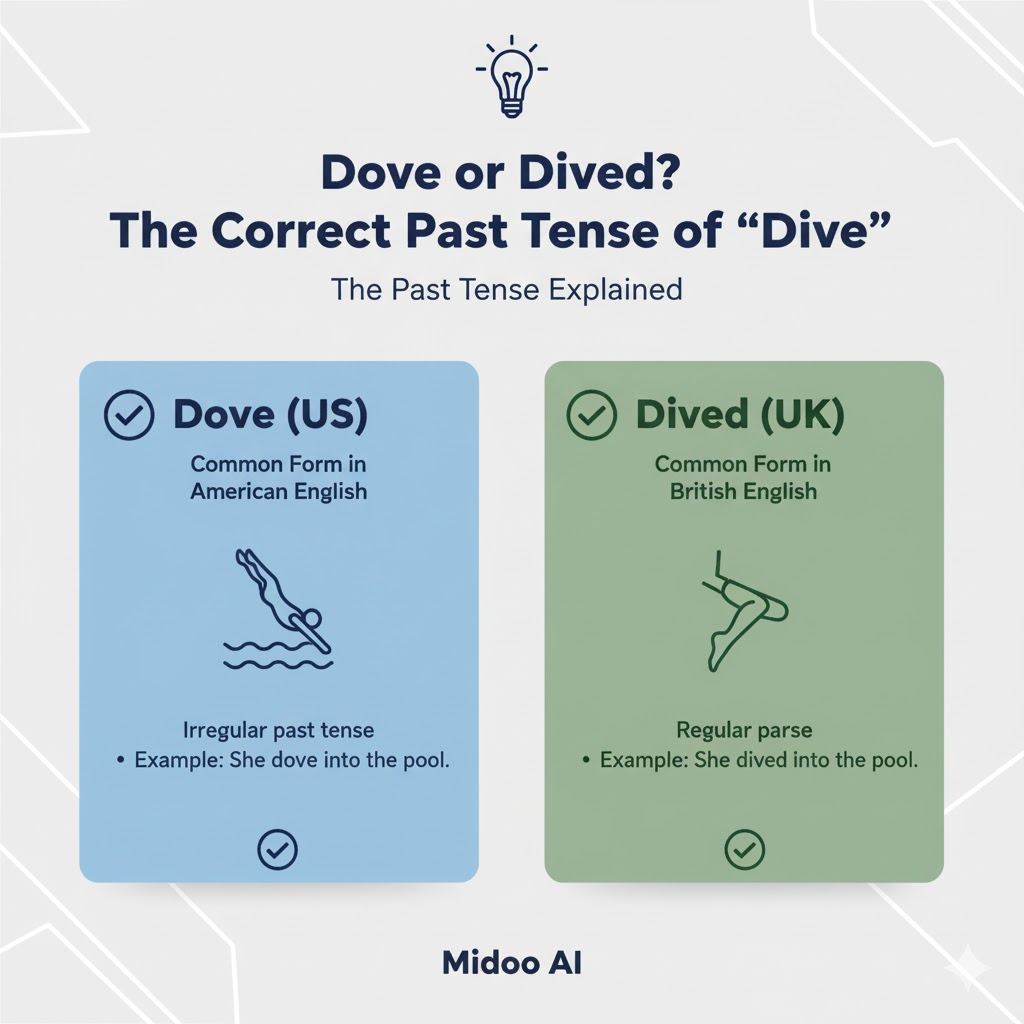

The main difference between dived and dove is regional preference and formality.
Comparison Table
| Feature | Dived | Dove |
|---|---|---|
| Meaning | Past tense of dive | Past tense of dive |
| English version | British English | American English |
| Formal writing | Preferred | Less common |
| Everyday speech | Common | Very common in the US |
| Example | She dived into the pool | She dove into the pool |
Both forms describe the same action. The choice usually depends on location and writing style.
Why Two Past Tense Forms Exist
English verbs often change over time. Some verbs develop multiple past tense forms.
For example
Dream → dreamed or dreamt
Learn → learned or learnt
Dive → dived or dove
Originally, dived was the only past tense form. Later, American English created dove by analogy with verbs like drive and drove. Over time, dove became popular in the United States.
Real World Examples of Dived vs Dove
Example One Sports Commentary
A reporter may say the goalkeeper dove to save the ball during a soccer match.
Example Two Academic Writing
A student writing a report might write that the researcher dived into the water to collect samples.
Example Three News Writing
Journalists often prefer dived because it follows traditional grammar rules.
Example Four Everyday Conversation
Many Americans naturally say dove in casual speech.
These examples show that both forms work correctly depending on context.
Regional and Global Usage
British English strongly prefers dived.
American English commonly uses both dived and dove.
International English usually accepts both forms but favors dived in formal writing.
If you write for a global audience, dived is usually the safest choice.
Advantages and Disadvantages
Advantages of Using Dived
- Accepted worldwide
- Preferred in formal writing
- Recommended by many grammar guides
Disadvantages
- Slightly less common in casual American speech
Advantages of Using Dove
- Very natural in American conversation
- Widely used in storytelling and sports commentary
Disadvantages
- Some teachers consider it informal
Common Mistakes in Dived vs Dove
Mistake One Thinking One Form Is Incorrect
Some people believe dove is wrong. In reality, both forms are correct.
Mistake Two Mixing Regional Styles
Writers sometimes use British spelling but American verb forms. This can create inconsistency.
Mistake Three Using the Wrong Past Participle
The past participle should usually be dived.
Example
Correct: She has dived into the water.
Less common: She has dove into the water.
Mistake Four Forgetting Context
Formal essays usually prefer dived.
Related Verb Comparisons
English contains several verbs with two past tense forms.
Burned vs Burnt
Learned vs Learnt
Dreamed vs Dreamt
Spoiled vs Spoilt
Like these verbs, dive developed two acceptable past tense forms.
Beginner to Advanced Understanding
Beginner Level
Both dived and dove mean the past tense of dive.
Intermediate Level
Dived is traditional and used in formal writing. Dove is common in American English.
Advanced Level
Many grammar experts recommend using dived as the past participle while accepting dove as an alternative simple past tense.
Exercises With Answers
Question One
Which form is preferred in British English
Answer Dived
Question Two
Which form is common in American speech
Answer Dove
Question Three
Do dived and dove have different meanings
Answer No they have the same meaning
Question Four
Which form is safer for academic writing
Answer Dived
Question Five
Can both forms be correct
Answer Yes both are correct depending on context
FAQs
Is dived vs dove the same verb form?
Yes. Both words represent the past tense of the verb dive.
Which spelling is correct dived or dove?
Both are correct, but dived is considered more formal and traditional.
Is dove wrong in English grammar?
No. Dove is widely accepted, especially in American English.
Should I use dived in academic writing?
Yes. Most style guides recommend dived for essays and research papers.
Why do Americans say dove instead of dived?
American English often created new past tense forms influenced by similar verbs like drive and drove.
Do dictionaries accept dove as past tense?
Yes. Most modern dictionaries list both dived and dove as correct forms.
Which form should international writers use?
International writers usually choose dived because it is globally accepted.
Is dove the past participle of dive?
Usually dived is used as the past participle in formal grammar.
Conclusion
Understanding dived vs dove helps writers choose the correct past tense depending on context and audience. Both forms describe the same action of jumping or plunging downward, usually into water. The main difference lies in regional usage.
Dived is the traditional and widely accepted form, especially in British English and formal writing. Meanwhile, dove appears frequently in American English and informal speech. For academic or international audiences, using dived is usually the safest choice.
In everyday conversation, especially in the United States, dove sounds natural and widely accepted. Therefore, the best approach is to choose one form based on your audience and remain consistent throughout your writing.