
Quick Answer
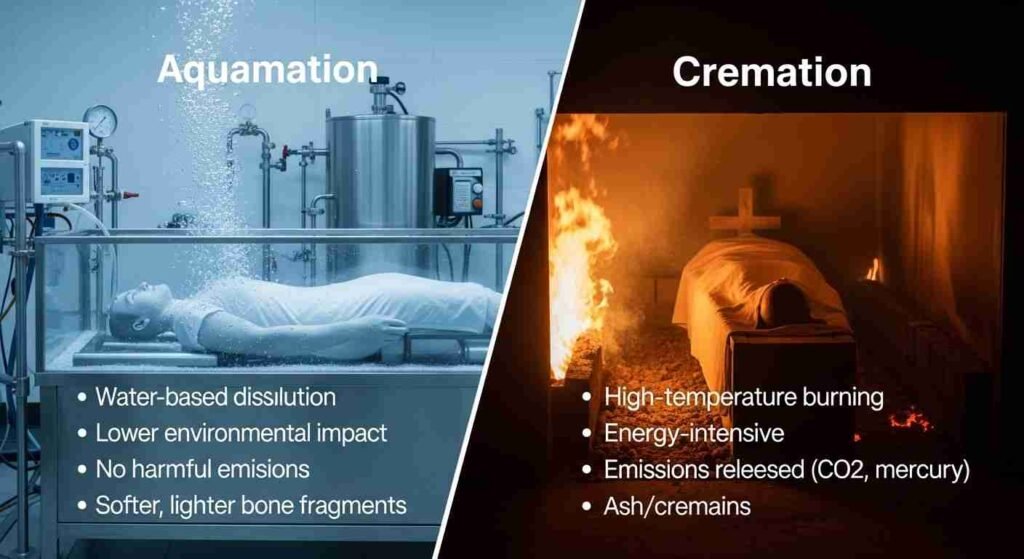
Aquamation and cremation are two different methods of body disposition after death. Aquamation uses water and a gentle alkaline solution, while cremation uses high heat and fire. Aquamation is more eco friendly, whereas cremation is more traditional and widely used.
Many people compare aquamation vs cremation when choosing end of life options. Both methods replace traditional burial, but they work in very different ways.
Cremation uses high heat to turn the body into ashes. In contrast, aquamation uses water and natural chemicals to break down the body gently. Because of this, their environmental impact, cost, and acceptance vary.
Today, more people look for eco friendly options. Therefore, aquamation is becoming popular. However, cremation remains the most common choice worldwide.
Understanding aquamation vs cremation helps families make informed and respectful decisions.
Quick Overview
Aquamation uses water based process
Cremation uses fire based process
Aquamation is eco friendly
Cremation is widely available
Both return remains to the family
Key Difference Between Aquamation vs Cremation


7
The main difference is the method used.
Aquamation uses water and alkaline solution
Cremation uses intense heat and flames
How Aquamation Works


Aquamation uses a sealed chamber filled with water and natural solution. Heat is applied gently. Over time, the body breaks down naturally. The remaining bones are dried and turned into powder.
How Cremation Works


Cremation uses a high temperature furnace. The body is exposed to extreme heat. Afterward, bone fragments are processed into ashes.
Comparison Table
| Feature | Aquamation | Cremation |
|---|---|---|
| Process | Water based | Fire based |
| Temperature | Low | Very high |
| Environmental impact | Low | Higher |
| Energy use | Less | More |
| Availability | Limited | Widely available |
Environmental Impact
Aquamation uses less energy and produces fewer emissions. Therefore, it is considered environmentally friendly.
Cremation, however, requires high heat and releases carbon gases. As a result, it has a higher environmental impact.
Cost Comparison
Aquamation can be slightly expensive because it is not widely available.
On the other hand, cremation is more affordable and easily accessible in most places.
Cultural and Religious Views
Cremation is accepted in many cultures and religions. Therefore, it is widely practiced.
In contrast, aquamation is still new. As a result, many traditions have not fully accepted it yet.
Advantages and Disadvantages
Aquamation Advantages
Eco friendly
Low emissions
Gentle process
Aquamation Disadvantages
Limited availability
Less awareness
Cremation Advantages
Widely available
Affordable
Culturally accepted
Cremation Disadvantages
Higher emissions
Uses more energy
Real World Examples
A family chooses aquamation to reduce environmental harm.
Another family selects cremation because it is traditional and available.
In some regions, aquamation is not available, so cremation becomes the only option.
Common Mistakes
Many people think both methods are the same
They are completely different
Some ignore environmental impact
Aquamation is more eco friendly
Some assume aquamation is available everywhere
It is still limited
Related Comparisons
Burial vs cremation
Green burial vs aquamation
Traditional vs modern funeral methods
Beginner to Advanced Understanding
Beginner Level
Aquamation uses water
Cremation uses fire
Intermediate Level
Aquamation is eco friendly
Cremation is traditional
Advanced Level
Choice depends on environment, culture, and availability
Regional and Global Usage
Cremation is common worldwide.
Meanwhile, aquamation is growing in developed countries. However, laws vary, so availability differs by region.
Exercises With Answers
Question One
Which method uses water
Answer Aquamation
Question Two
Which method uses fire
Answer Cremation
Question Three
Which is more eco friendly
Answer Aquamation
Question Four
Which is more common
Answer Cremation
Question Five
Which has higher emissions
Answer Cremation
FAQs
Is aquamation better than cremation?
Aquamation is more eco friendly, but the choice depends on personal preference.
Is aquamation legal everywhere?
No, laws vary by location.
Does aquamation produce ashes?
Yes, it produces similar remains.
Is cremation harmful to the environment?
It produces more emissions than aquamation.
Which is cheaper?
Cremation is usually more affordable.
Why is aquamation becoming popular?
Because it is environmentally friendly.
Can families keep remains?
Yes, both methods return remains.
Conclusion
Aquamation vs cremation is an important comparison for modern decision making. Aquamation uses water and is eco friendly, while cremation uses fire and is more traditional.
Although both methods return remains to the family, they differ in environmental impact, cost, and availability. Aquamation produces fewer emissions, while cremation remains more common due to accessibility.
Ultimately, the right choice depends on personal values, cultural beliefs, and local availability.